Sunday, September 15, 2019

Peeking into Posey: Part 1


If you’re not from the Midwest, what do you know about the area? Would you like to know more? If you live there—particularly in southern Indiana—are you curious about surrounding counties?

I am a native southern Hoosier, yet I readily admit to ignorance of much of my home state. I’m slowly fixing that and I’m starting in the lower left corner of the state map, Posey County.

This is the first of several installments I intend to write as I learn more about the toe of Indiana, or, if you’re facing west, our leading edge. 

The Game Begins


“Good things come to those who wait.” 

I question that as an unqualified truth. My car’s dashboard report read, “ENGINE OIL CHANGE ALMOST DUE”. That was a fib, if not an outright lie. I knew full well I was 2,000 miles beyond the suggested change date. Waiting any longer seemed imprudent.  

We no longer have a business in my hometown that will do oil changes on demand. Thus, a day of wandering with my wife began by moving among Indiana counties. 

In northern Indiana, most of the counties look like a great Architect told his or her helper to hold one end taut as they snapped a chalkline. County borders are mostly right angles. Not squares, but sharply defined shapes, like a haphazard chess board. So, with my Queen beside me, let the game begin.

Move 1: Daviess to Knox


In the lower southern counties of Indiana, the shapes begin to look as if the helper wandered off at a critical moment and the string went slack. Or perhaps as if the counties are being crushed by the burden of the great wall of counties they are supporting.

We’re rather proud of that burden. We know it’s our coal, our timber, our rivers, and the beauty of our counties that are contributing greatly to the success of our state.

Clearly, these irregular borders—though set by man—were determined with Nature in mind. Waterways divide counties and even states, going where they will despite the inconvenience to surveyors. 

With our engine successfully lubricated and our tires fully inflated, we were free to wander once more. But with purpose. A Posey purpose.

Move 2: Knox to Gibson


Moving south down Highway 41, we drove through Gibson county to Interstate 64, taking the interstate west toward St. Louis. More on this county and its points of interest in a future post.

Move 3: Gibson to Posey


We exited I-64 at Frontage Road in Poseyville, which despite its promising name is not the county seat of this sprawling county. Did I say “exited”? I should probably have said “excited”, because there, beside the interchange, was a large metal building surrounded by attractive planting beds and sufficient parking for a horde of people. It was the Red Wagon restaurant.

Red Wagon Sign (Picture from theredwagonrestaurant.com)

Wagon Ho!

The Red Wagon Restaurant & Bar (picture from theredwagonrestaurant.com)


I’d heard of this establishment from a prospective client and was eager to try it. Inside we found artwork proudly depicting local businesses and landmarks, country-themed crafts and gifts, and thick wooden tables with solid wooden chairs made to withstand the wear and tear of generations of patrons. A widely varied menu caused us some consternation. We knew we’d only be able to try one meal at this sitting. Ah, well. It’s good to have a place where we’d like to spend much more time.

Dear in the Headlights


It’s nice to be seated and be addressed as “Dear.” I did a mental double-take at first, but it wasn’t affected. It was simply that person’s sense of hospitality, setting us at ease, letting us know we were welcome, and that we would be taken care of like family. Possibly better, depending upon your family.

Having tended to our hunger, we continued south. I said we were wandering, but I don’t mean to infer we had no purpose. In Mt. Vernon, they were celebrating River Days. But first we had to get there.

Destinations


There are three major towns in Posey County: Poseyville, New Harmony, and Mt. Vernon. It seems unfair to focus on those three, because in a county that encompasses 410 square miles, a person will not see it all in one day. But, loosely, those were our destinations. We look forward to returning to Poseyville and seeing more than The Red Wagon.

From our location, Mt. Vernon was another 30-minute drive. If you just want to be someplace, 30 minutes is an inconvenience. When the landscape is attractive, the time and distance are no matter.

Subtlety in Color


As we drove, I wondered how the scenery between Poseyville and Mt. Vernon would appear to a casual visitor. They might say, “It’s all green.” True-ish. It was mostly greens. Bright greens, light greens, and fading greens brightly lit by sunshine and standing in contrast to a beautiful blue sky. No promise it’s always this way, but it was an excellent day to be enjoying the views.

I think it’s important to appreciate this color palette because the roads we traveled went through agricultural land. I can imagine the greens giving way to browns later in the season and through the winter, then rich browns developing a greenish cast as seeds germinate and thrust through the soil to drink in sunlight and rain. From there, the cycle would repeat itself as it has since man has decided turning over the earth here and planting seeds is a good idea. And that notion goes back to the Hopewell Native American culture who lived in the area 500-200 BCE. 

Knowing you’ll experience these colors, let me tell you where we saw them. 

Corn. Tall tasseled stalks were green from the ground up the stalk, with brown leaves where moisture and chlorophyll had receded. Just an indication of the approaching harvest, when the stalks will be more completely brown and nature will have done a significant part of the drying process. 

Soybeans. We saw large swaths of beans--verdant, leafy plants with vivid yellow crowns. They were completing their stationary march through the season. 

Hay. Large, round bales dotted a field, punctuation marks on the landscape. A twisted tapestry of yellow, brown, and green that would continue to fade until one winter day when it became a welcome offering to livestock in a snow-covered pasture.

So much to see on these curving roads. And we weren’t even near Mt. Vernon, yet. But we were getting close.

Mt. Vernon


As we came into town from the north, the first thing we saw was the bright, white cupola of the courthouse. Soon, we saw its red brick walls as well. As in so many population centers, this symbol of law and justice is prominently displayed among other important Government offices and is not only impressive, but attractive with many old and newer architectural flourishes.

Posey County Courthouse, Mt. Vernon, Indiana


What is that smell? Do you ever get a whiff of something and you just turn until the aroma gets stronger? I did. It led me toward the river, but that was not the source. No, River Days was the scene of a flurry of activity interspersed with a lot of patience. The flip side of goodness coming to those who wait. Smoking was definitely permitted. Seemingly everywhere. Small rigs and large setups lined the streets. You knew people had awakened very early to prepare the meats they were entering in a smoked meat competition. Oh, my goodness. If we hadn’t come directly from the Red Wagon, I’d have been out some serious coin sampling what I was smelling. Other vendors had trailers and booths, purveying sweet beverages, fried delicacies, public awareness, hand-made crafts, clothing, and even an infant changing station. (The latter was not for trade-in, just normal maintenance)

We enjoyed a show by Indiana WILD (https://www.facebook.com/Indiana-WILD-124745117580115/), and petted our first Fennec Fox and a Ball Python. We admired the Riverfront park, the bike trail, and the new, expanded sidewalks along Main Street. I even ogled a motorcycle or two.

Indiana WILD and John, a young man who knows an astonishing amount about animals.


We wished we had more time, but there were a couple of stops we still wanted to make. One of our greatest desires was to walk in the shade.

Harmonie & (New) Harmony?


Seventeen miles north of Mt. Vernon, just a couple of miles from State Road 69, is Harmonie State Park. After paying the $7 entrance fee and talking with a gregarious ranger about the park amenities, we drove around the large loop that provides access to many ways visitors can experience the outdoors. Harmonie has a swimming pool during the summer, rental cabins, campsites with electricity, areas for tent camping, hiking and biking trails, a nature center, and a boat ramp that lets into the Wabash River.

If you expect the lowlands around rivers to be completely flat, rethink. As we drove the loop, the wooded areas to either side can best be described as wrinkled. Deeply wrinkled on a scale that can provide challenging hikes or bike rides, if that's your wish. For those less adventurous, there are also plenty of flatter stretches where you can exercise at a more moderate pace. The walk along the Wabash from the boat ramp to the playground was particularly pretty. On the Illinois side, a family had pitched a large dining tent on the sandbar and played alongside the water.

Weathered stump.

These trees were probably victims of our spring rains and flooding. Upstream is evidence of further submerged snags. Despite these possible dangers to boaters, what a beautiful day!


From Harmonie, we went four miles further north along Maple Hill Road to New Harmony. Along our route as we entered town, people were carefully tending their properties, contributing to the sense of neatness and civic pride that pervades the town. We arrived too late in the day to enjoy shopping, but we did walk around a public garden area and enjoy a dinner at Sara’s Harmony Way. 

Thankful somebody took the time to patiently train the vines embracing this garden seat and arbor.

Russet foreshadowing crunches underfoot around this space for reflection.

The rare and beautiful New Harmony Tree Fairy capturing a memory.


At Sara's, we elected to sit on the patio. Its ridged spherical black bubbler fountain, large fire pit, and comfortable seating has a welcoming funky vibe. Enamel metal eating utensils and tableware hang from beaded strings, softly clinking and clanking in the breeze. A chunky, weathered, red fire hydrant showing yellow patches stands near a metal trellis strung with fairy lights. 
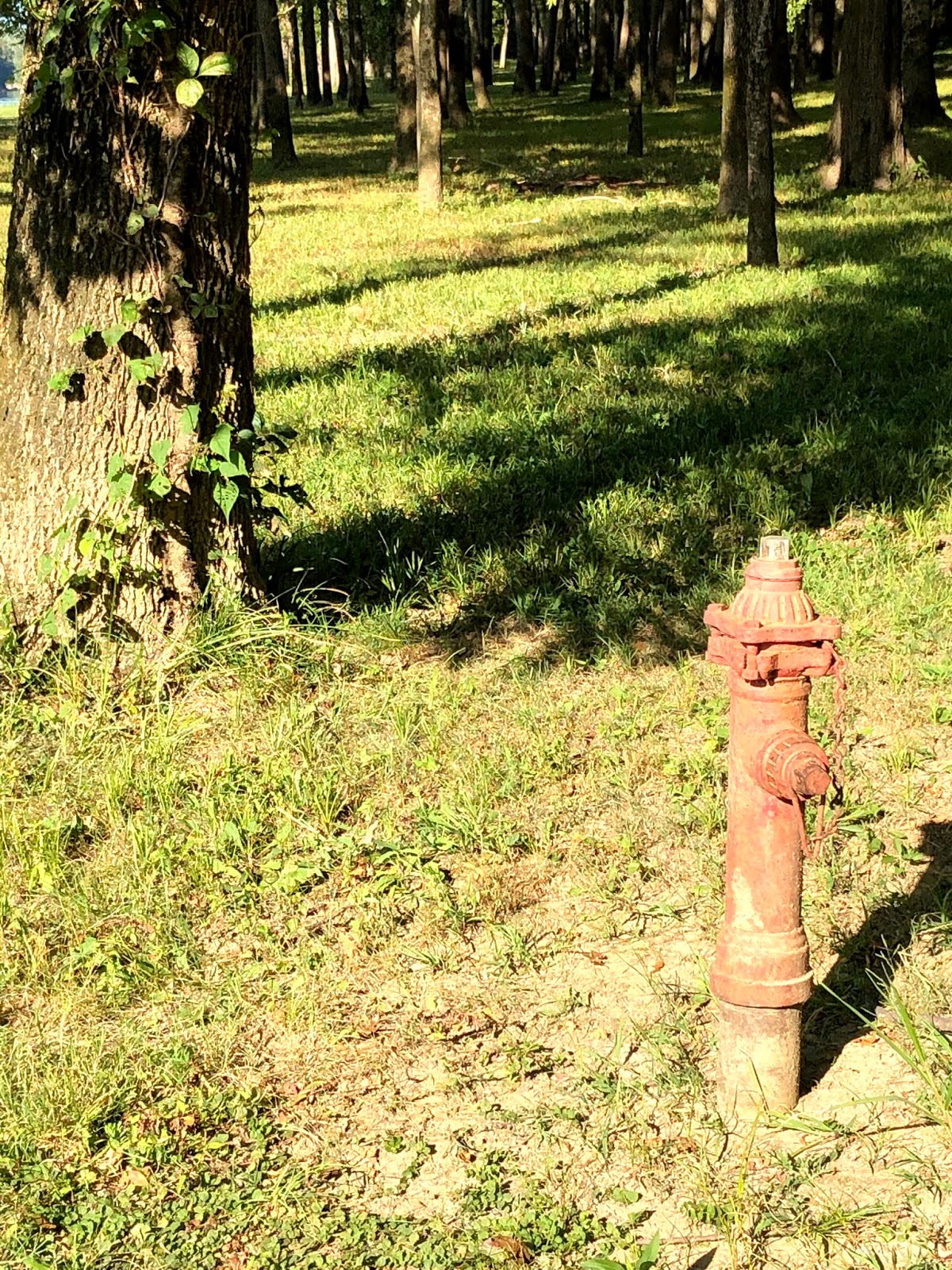
This hydrant at the Harmonie State Park boat ramp seems reduced in stature.
But this one at Sara's Harmony Way is more robust, if not nearly so effective when called upon.


Because you never know when you might need a hydrant. Water provided separately. The patio was an excellent use of the space and adds to the air of congeniality of the establishment.

Finally, it was time to turn the car toward home. 

Moves 4-8:

4. Posey to Gibson
5. Gibson to Vanderburg
6. Vanderburg to Gibson
7. Gibson to Pike
8. Pike to Daviess

Game over. For now. 

This was a much needed date day away. Now we look forward to learning more about Posey County and its attractions. Next time with friends.

If you have a special place in Posey County we should visit, let me know!

Sunday, September 8, 2019

On the Run: Creating a Day Well Spent

In a day full of firsts, we attended a local auction, visited the first National Park dedicated to the Northwest Territories, and enjoyed a backyard concert well inside the city limits. And it was all very good.

What Am I Bid?

No pictures here, but we left late in the morning to meet friends at Graber Auctions. They were selling a vehicle.

We arrived and heard the auctioneer's patter. It was being broadcast to the crowd from speakers fitted into a camper top on an old, black Ford F150. The truck had become a rolling platform that moved slowly down a lane between items consigned for auction. In this case it was lawnmowers, riding lawnmowers, BIG riding lawnmowers, tractors, tillers, four-wheeler utility vehicles, golf carts, box trucks, racing trailers, and at least one box scraper my friend had his eye on.

Inside the camper, with two broad windows on either side propped open like awnings, sat auctioneer Mark Graber and an assistant. They worked their way through items to be sold, dispensed keys as needed to prove an item would start, and coaxed the assembled bidders into better prices for the seller. When possible. Mark didn't push, didn't linger when a reserve clearly would not be met, and worked diligently to be fair to all parties.

It was a study in humanity. I was wearing bib overalls and I was not out of place. Many attendees had not seen a barber in quite a while and had no idea where the shaving products are at Walmart. There were older men wearing bibs, jeans, or cargo shorts and tennis shoes or scuffed work boots. Younger guys wore shorts and t-shirts, some with amputated sleeves. About half wore ball caps with well-smudged brims testifying that they had no fear of dirtying their hands. And one gentleman had a black cowboy hat, a western shirt with piping, jeans and cowboy boots, and a prominent belt buckle of the Mercedes-Benz logo. Pretty snazzy.

Young families were out, carting infants and toddlers in carriers and strollers. And everybody was looking for that one irresistible bargain. Our wives had had sufficient exposure to the bright, hot sun (and possibly the dusty gravel, the din of commerce, and the crowd). They left us.

We waited for Mark to work his way through the items. Eli, another of Mark's assistants yesterday, moved from one item to the next. He had a pole about 5 feet tall with a blue sign atop it that told bidders, "This is the item being auctioned right now" or something similar. Nobody wants to bid on the wrong item. Or to listen to the pleas of somebody who has just done that.

We waited through a series of lawn equipment -- Husqvarna, Scag, Ferris, Cub Cadet, Snapper, Dixie Chopper, John Deere -- and eventually Paul, who was driving the truck Mark worked from, turned around and started back up the lane.

We had agreed that $150 was a good top bid for the box scraper. Mark started the bidding at $100 and it moved smoothly past our comfort zone. Somebody took it home for $175.

As we walked away, slightly disappointed but none the poorer, my friend mentioned how important it is to stick to your guns and not get caught up in "auction fever." I felt safe. Showing up with nothing to spend goes a long way toward that type of resolve.

Getting to Know Knox

Our next stop was Knox County. In particular, the town of Vincennes. It all began at Old Chicago Pizza and Tap Room. Try the Chicago 7 ("Pepperoni, Italian sausage, red onions, black olives, green peppers, sliced mushrooms and cheese of course!") on a deep dish crust. 

We have a National Park?

Being a "flyover" state, we Hoosiers are accustomed to doing without in some respects. When we think National Parks, we think Yellowstone, the Grand Canyon, etc. But we have one. Not 30 minutes from our home. It commemorates an inspiring movement of a small group of combatants through daunting terrain to take possession of three towns for the newly formed United States. 

If you come to southern Indiana (and why wouldn't you?), visit George Rogers Clark National Historical Park in Vincennes. The park is on the site of Fort Sackville beside the Wabash River. The fort is gone, although you can see a model of the fort at the Visitors Center. In its place you'll find the George Rogers Clark Memorial.


I had read stories of Clark, his Long Knives, and their activities in the area during the American Revolution. Don't miss the video presentation at the Visitors Center. It may help you appreciate the  accomplishments of Clark's command during his Illinois Campaign in the Northwest Territories. It put a face onto history for me.

This piece of American history is also reenacted annually each Memorial Day at the Spirit of Vincennes Rendezvous.


The Wabash

Since we were so close, we exited the Visitors Center and walked the few yards to the Wabash River.


The Lincoln Memorial Bridge is one of the most attractive bridges in the area. It connects Indiana and Illinois at Vigo Street.

Vigo is a name attached to many things in the Knox County area. It refers to Giuseppe Maria Francesco Vigo, better known as Francis. Vigo was a former Spanish soldier and fur trader who moved his trading business from St. Louis to Vincennes. He was an Italian-born informant to the American military, captured by native Americans, held by the British as a Spanish citizen and released at the insistence of the French. If you like international studies, I think you've come to the right place.


Pride of Place

Do you have a symbol that is important to you? It could be something of religious significance, a seal of a fraternity or sorority, or even a tattoo you commissioned especially in honor of a person or event. Given the French heritage of Vincennes, the fleur-de-lis has particular meaning here. You'll see it in the city flag and in place throughout the town. One of those places is in metalwork. This is part of a covered bus stop outside Old Chicago Pizza and Tap Room.


Vincennes is not bashful about its famous natives, either. 


Richard Bernard Eheart, probably known as Red Skelton to you, was one of those natives. Skelton believed that his life's work was to make people laugh; he wanted to be known as a clown because he defined it as being able to do everything. He had a 70-year-long career as a performer and entertained three generations of Americans. His widow donated many of his personal and professional effects to Vincennes University, including prints of his artwork. They are part of the Red Skelton Museum of American Comedy at Vincennes.


More Than Bricks

It's not immediately apparent in the preceding picture, but the building facades on Main Street have beautiful architecture. The ornamentation is a reminder that architects throughout the years were very aware they were creating not just a building, but a place. They felt that place was worth the effort to ensure it is memorable.

In addition to the beauty, I like the surprises. I keep coming back to this wall that was revealed when the building beside it was torn down.


I like the Schulteis Brothers sign painted on the brick. I like the vine that branched so widely in search of light and has been left in place. How will we know about the present in context, or plan the future, if we can't see the past?


Our visit to this sliver of Knox County came to a close. We returned to Washington and continued our streak of supporting the local Knights of Columbus Treasure Hunt by paying for five numbers and not being drawn. Thankfully, we've seen so much of the money collected put right back into the community for excellent causes. So now they have five more dollars to work with.

Guilty As Charged

After assuring ourselves we were unburdened by a surplus of funds, we went to a beautiful old home nearby and enjoyed hospitality, friendship, and music. That creates an incredibly positive vibe and it was a pleasure to see classmates, neighbors, and friends trickle in with blankets and folding chairs, set up, and enjoy the moment with us.

As a joke, we of the Class of '78 picked up instruments for a photo opportunity. Mr. Joe Howard, classmate and band member in Guilty As Charged, graciously handed out his guitars to us. I was not going to take one, but he said, "Dave. It's a 1959." Quickly figuring the value of what he was offering, I put it on. How often do you get a chance like that!?


Cheers. To a day well spent. And I hope yours was, too.


Sunday, June 16, 2019

Value the Mundane

Do you value the mundane? I do, but not often enough.

This morning, after a busy weekend, I have arrived at the coworking space where I write and I am anxious. It’s a season of transition for me and several activities are simultaneously in play. There are “important” things I can and should be doing. But an anxious attitude almost certainly will scuttle my efforts. So, now I’m anxious about my anxiety? That’s helpful.

Among my low-level tasks to do is calendar prep. I use a daily planner that comes in four quarterly books. The pages and calendars are undated. To use this planning system, once each quarter I must allocate time to put dates in the upper left corner of each calendar block for the three monthly calendars. I must also enter a date on each of the daily pages I will use during that quarter. It’s tedious. I don’t like it. But I need it.


I recently received the book for the next quarter. Since I was too agitated to do my best work, I pulled the planner from the shelf and began filling the blanks. It was a tonic. The task demanded sufficient focus to distract me. If I put the right date in the wrong box, I could ruin my entire month, after all. Also, I realized my writing needed to be legible, so rushing was not advised.

Anatomically Correct
One of the most fascinating things I’ve seen recently is a pair of digital dissection tables used in the Department of Health Science at Gettysburg College. Thanks to people who have donated their bodies to science, and the incredible patience of others who scanned and labeled those bodies slice by slice, we can clearly see all the pieces that comprise the human body.

For every large, strong bone there are a number of smaller bones. Like the ones that help you find furniture in the dark. Arteries lead to veins and so on, delivering oxygenated blood and collecting depleted blood for reuse. The tables allowed us to isolate the circulatory system and see how that flow works. We could remove muscles and organs from the display and show only bones. We could remove bones from the display and zoom in on facial muscles.

This becomes apparent: we are complex beings with some familiar parts. Hard parts and squishy bits. Femur, tibia, ulna, heart, aorta, brain, lungs, etc. It’s the lesser known parts that keep us intact. A meme I just saw says “The average spine has approximately 100 joints, 33 vertebra, and 220 ligaments.” I trust the source. Especially since it supports my opinion that little supporting muscles, ligaments, and cartilage with relatively boring tasks keep us operating at our best.

In our daily living, the unexciting tasks can serve a similar purpose, rooting us in routine, aiding our focus, and coaxing us from our emotional ledges back into the safety of more controlled environments.

As you’re loading the dishwasher, sorting the laundry, making your shopping lists, dusting, or entering dates into your crisp new planner, take a moment to be thankful for the marvelous benefits of the mundane.

Saturday, May 4, 2019

Learning to Love Linen

I recently purchased two linen shirts. If you haven’t tried linen, the shirts feel extraordinary. They breathe wonderfully.

Linen has been used as clothing fabric so long that you can’t help but wonder if this isn’t what our ancestors felt as they dressed for the day.


If there is a disadvantage to linen, you’ll likely find it just as you’re pulling your shirt from the dryer. Linen is a highly opinionated cloth. That presents its own wrinkle, if you will.

I have credentials. I am no novice in the clothing maintenance game. When I left high school, I attended a six-week-long Government-funded course in the domestic arts. People in oddly shaped hats loudly extolled the virtues of hospital corners, aligning shirt plackets with trouser flies and belt buckles, the necessity of gleaming footwear of any variety, and a good haircut.

By this point in my life, I can probably iron a sharp crease into an I-beam. Linen, however, is not so easily swayed. I’m quickly developing a measure of empathy with my friends who have curly hair. Some things are going to do what they are going to do. Subject closed.

Linen almost always looks like it just awakened from a nap. It’s casual. Like a good ponytail. In fact, if you’re a ponytail fan, you’ll love linen. Think of it as a long-sleeved scrunchy. Just that comfortable and just that good.

Saturday, April 6, 2019

Some Tildes are Brown


If you’re at your keyboard, look to the left of the 1. There is an accent mark. It is the accent grave. Above it, there is a squiggle. Not surprisingly, somebody has named it, too. It is called a tilde and is pronounced like, “He’s gonna do that tilde cows come home.”

You may have seen tildes doing what they do best. They nap atop letters like n in Spanish, changing a crisp “na” to a mushy “nya”. If you’ve seen SeƱor, you’ve seen your tilde.

I see them other places. Like our yard.

By the way, does green sneak up on you? As I’ve been driving around, I’ve noticed my Midwestern world on the cusp of Spring. The maple in our back yard is an early budder and has been prepping for this moment since February. Now the red buds are bursting and they are everywhere. Last week, our patio roof looked like a warning for measles. Today, maple buds are a spotty carpet on our lawn and driveway.

Chloroplasts all over the place are chock full of chlorophyll, channeling the energy of sunlight into chemical energy, converting it through the process of photosynthesis. Chlorophyll is a changer. It absorbs energy to change carbon dioxide and water into carbohydrates and oxygen. It turns solar energy to a form that can be utilized by plants, and by the animals that eat them. It is the foundation of the food chain.

We don’t see that. We see green. More and more green. We had to pull the green out of our closets for St. Patrick’s Day. Now we just open our doors or look out our windows. Something is definitely happening out there.

But this was about tildes.

Speaking of the food chain, we have a bird feeder under the eaves near the end of our garage. Birds are not fastidious. They make a mess. Enter the squirrels. They pick up uneaten sunflower seeds. They find nuts. They share space with doves, ducks, and geese beneath the feeder gleaning enough nutrition to keep them sassy and happy.

We often see the squirrels zipping up the tree or a telephone pole or fearlessly balancing on utility lines or narrow branches. But my favorite view of them is in motion on the ground. Their tails and bodies are a sinuous curve of motion. Furry brown tildes flitting, scampering, or running atop active chloroplast factories that are changing our world from drab to green.


Thursday, June 14, 2018

Just a Twig, But ...

Sometimes it's hard to remember that we're more than us. I mean, you're more than you. I'm more than me. If you were raised in a small town, you may have left at the first opportunity and you may have stayed away. But it's in you. It's with you every day. Many of your thoughts were shaped in the social gatherings you attended, the schools, and the extra-curricular activities in that town.

Your family may have been a part of that community for years. If not, certainly the families of your friends were. Despite the eager diaspora of young people in pursuit of adventure and success in a setting that doesn't look just like yesterday to them, a small town is a place of roots.

Do you ever feel disconnected? Small?

Maybe something like this: moderately flourishing, a few blemishes, some opportunities for future growth, but all in all not certain you are big enough to thrive.
Take heart. I found this pin oak stem on the ground earlier this evening. It's so easy to look at it and think, "You're not that much." But there's more to the story. That's so often true.
Everything comes from someplace. This twig was separated from a branch. The branch was part of a tree. The tree had been there a while.
There by the barn stand Dale and Jack. They are talking about the age of the tree in the foreground. It's conjecture, because neither of them is willing to cut down the tree to see who's right. They don't have the tools, they don't have the energy, and they would have to find another shady spot to stand in afterward, so the answer to the question remains a point of pleasant conversation--something too often overlooked, if you ask me. Since you didn't,  let's get back to our topic.

I show you this view of the tree for a sense of scale. Irrefutably, it began life looking much more like the first picture we looked at. Somehow it thrived. If you lived around it, you'd probably say it's old. It's slow. You can't see its growth. It's happening, but it's not something you remark on until you leave and return. Then you notice that the height is the same, but branches have gotten thicker. Heavier. the canopy has spread. And as Dale pointed out, there is a lot of wonderful shade.

Old. Slow. No growth. People talk about more than trees that way.

The trunk of the tree we've been considering is thick. The man you see in the picture below is not what you would call a tree hugger, but he appreciates them. In this case, he's extending his span to get an idea just how big around this tree is. Full disclosure: this man is my father, so you can damn skippity bet that he is the Sir in circumference.
We put the best minds available to work on this one. That included Mom and Dad's dog, Millie. We decided it's pretty big. Probably at least 25 feet around. Possibly 30 feet or more. Let's step back a bit and appreciate the size.

Just a few more steps. Who am I kidding? Let's keep walking until we're in the neighbor's yard and most of this tree fits in the frame of the picture. 
Wow. Now remember when I suggested that we are more than us? Two men stand at the base of a tree. One tree. They are dwarfed by its immensity. One man sees a piece of pointed greenery on the ground. There is absolutely no question that it came from the tree. If we had the means on the spot, we could scientifically prove it. You and I are no different.

If people just knew what to look for, they would see our community in us. Whether we've remained where we were born, returned to it, or continue to carry a bit of it with us, we are dwarfed by its scale. In those moments when we have trouble believing in ourselves, we have so many generations of people who preceded us to look to. Each did something to create a life for themselves and their families. It may not have been monumental, but it was significant. Each act of each person is threaded into the history of a place we have called home. We are part of that same stock by blood or by association.

It's not all good. What is? Even the finest tree has knots, scars, and branches that don't look just right. But step back and look at the whole. It has a beauty.

At the local museum, we're assembling stories to display on a new piece of equipment. Our storytellers are combing through objects in our collection, photographs from our archives, and family histories that people have submitted. I sometimes wish everybody could do that. The stories you learn as you're building the story you're telling are fascinating. When I left town, I had no idea of the richness of the history in my mirrors.

So, I'd like you to do one of two things.

1. Find the biggest tree you can. Get near it and look up through its branches. Sit underneath it and listen to the sounds around you. Take a picture of it and post it online.

2. Find something you especially like about your hometown. It can be people. It can be a place. It can be something just outside the town. Take a picture of whatever that special thing is and post it online. Learn about its history until you find at least three things you didn't know.

Whether you chose #1 or #2, encourage, challenge, or browbeat (depending on your area of particular giftedness) somebody to do the same thing.

The more we know of our own stories--which includes our communities--the stronger our tree will be.