Monday, April 13, 2015

What a Home Ought to Have

I thought my wish list for a perfect house was pretty complete. Then I looked outside.

Back story

We've been thinking a good bit about houses lately here at Casa CoalBear. We are sprucing up the one we live in and thinking of one we'll move to. 

I expect most of you are either normal or exceptional. Please know that some of the rest of us bravely shoulder the burden of chronic dissatisfaction. You may be married to a person like this. You have my sympathy. My wife is too. Here's how you know. Your furniture spontaneously rearranges itself when your back is turned. Glossy brochures of new automobiles appear on your coffee table. You'll have conversations--more truthfully, you'll listen to monologues--about how your house would look if we could just eliminate that wall.

If you are married to such a person, sites like Houzz are an addictive substance and should be rationed by a caring third party before somebody succumbs to creative possibility overload.

I've perused Houzz quite a bit. A bunch. Lots. And I thought I had this next house thing figured out. 

Oh, Wouldn't That Be Lovely?

Here are a few things that, while not imperative, would be enticements to me.

H2O. The house I can happily go to sleep dreaming of has a water view. It doesn't have to be waterfront property. A glimpse will do. But from some point in the house, occupants can see light dancing on waves, fish jumping, birds hunting, and even on inclement days they'll see the surface of the water gossiping about the moody weather.

Porch. The weather won't keep people inside because this house will have a deep porch, so deep that quite a few musicians can gather there and stay dry no matter how hard the rain is falling. The porch has a wide wall, ideal for sitting on and just below the wall are thick, soft bushes in case any guests have difficulty prioritizing drinking and safely perching. 

Outbuildings. The third 'Oh, Wouldn't that be Lovely?' item is a large pole building that will hold a couple of vehicles, a shop, and the stuff that we refuse to clutter the house with this time but still won't let go of. 

The rest of the shopping list is the usual -- a couple of bedrooms, a kitchen, some bathrooms, a laundry room, a family room, and space for a home office. Is that enough? Apparently not.

The Show

I thought I'd covered it all until I looked outside and remembered the show. My mother-in-law planted two magnolias to the side and front of this house. I think the next house ought to have magnolias and, if I get my druthers, I think they've already been there a good long while. I'm not ready to forgo the show.

If you don't have a magnolia in your yard, you should know that they are a glorious celebration of spring. They're a perfume worn for a day in the sunshine. They're a cascade of blushing petals gathered together like the loveliest fruit and weighing down the branches that hold them to sway in the breeze. The blossoms are translucent. When the sunlight finds its way into them, it's as if they've found their soul and each beams as brightly as any new convert, filled with the conviction that their story cannot be ignored. They are visually arresting. Against a blue sky, they are one of the finest color combinations going. 

For the gentlemen among you, magnolias are like lunchtime in the city, when the parks are filled with beautiful young women strolling, striding, or sitting in the sunshine, thrilled to be outside without a sweater or jacket. Honestly, in springtime don't all women become beautiful young women? It's a special time of year and a magnolia in bloom is a superb expression of it.


Youth has its day, but not without a little help. The contrast of these flowering buds with the aged branches that support them appeals to me as well. That's why a young magnolia just won't do. I want to see the marks of time, the scars of branches sloughed or cut, the age spots of lichen freckling the shady side of the trunk, and the thick solidity of a plant too stubborn to quit. I want to enjoy something that will be there after the blush of youth has become a pink carpet and dark waxy leaves have taken their place to shade all below.


I still have my dream list, but it was incomplete. I think a fine old magnolia is one more thing a home ought to have.

Sunday, March 22, 2015

Charles Towne Landing

This weekend is a getaway with family. My time with them is limited, so today was "Dave Day." I could do anything I wanted and I could drag three innocent victims with me. My main goal was to try out a new camera lens. Fortunately, I opted for the first opportunity and we "discovered" Charles Towne Landing, a 650-acre property that has become a state park.  This park is home to the beginning of European habitation of the Carolinas.

This is history, so without judgment let's just acknowledge that it ain't all pretty. These folks weren't much better at life than you and I are. The difference is that we have the distinct advantage of seeing how their lives played out. On the land we walked today there was dealing with indigenous people that ended poorly for them, there was slavery, there was servitude, there was--well, there was all the stuff that history is made of. On our part, that often amounts to refined finger pointing and a conviction we'd do things much better than our predecessors. Call me skeptical.

I wish I could share with you all that we saw and learned today, but that really smacks of making you sit through the slides of my summer vacation. It's bad enough that I'm even sharing my favorite photos of today's outing.

Please do not expect a cohesive story in the following narrative. Let's be honest. What we're dealing with is a distractible man with a camera. We're just lucky I remembered to remove the lens cap.

The Visitors Center had a special on entrance fees and walking audio tours. The museum was very nicely done and informative. Imagine leaving all you know and settling in a strange land. There was a lot of planning to gather the stores required to keep people alive. There was conniving and cajoling to get people to buy into this expedition as backers or participants. And there were disappointments. One of them was learning that what grows well in Barbados does not do well in the Carolinas. On the plus side, there was timber. Timber is a lovely resource for creating containers called barrels. Barrels are a lovely resource for creating coopers.

Thanks to the marvel of the Internet, wikipedia tells us about coopers and hoopers. "Traditionally, a cooper is someone who makes wooden, staved vessels, bound together with hoops and possessing flat ends or heads. Examples of a cooper's work include but are not limited to casks, barrels, buckets, tubs, butter churns, hogsheads, firkins, tierces, rundlets, puncheons, pipes, tuns, butts, pins and breakers. Traditionally, a hooper was the man who fitted the metal hoops around the barrels or buckets that the cooper had made, essentially an assistant to the cooper. The English name Hooper is derived from that profession. With time, many Coopers took on the role of the Hooper themselves."

In the interest of full disclosure, I didn't know all that and I didn't learn it today on our trip. But it is relevant because the tools pictured here are cooper's tools. And the laughing children running down the path beside the cooper's cabin while rolling a metal ring with a stick were undoubtedly the Hooper kids.

1. Cooper's Tools
For something completely irrelevant and out of the Colonial period, I offer you picture 2. I warned you I might not stay on task, but isn't this cool? One wall of the Visitor's Center is glass panels and this is how they are held together. Isn't that spiffy? Very industrial. Apparently, they are also effective. When I left the Visitor's Center and turned around, not one panel was missing. I suppose it gets sunny down here, and probably hot, too. Neither was an issue for us today, but the panels are all tinted and create a greenish cast on whatever you're viewing through them. The important thing is that you can view things through them. That's what led us outside the center and into the tour of the grounds.


2. Whizmo Glass Holding Thingy

My first stop was a pier connecting the Visitor's Center to ... well, to land. So much of this area is marshland that we'd be a filthy, muddy mess if somebody had not created piers, raised walkways, and paved pathways. Trips to the Chesapeake islands and the Atlantic seaboard offered similar vistas. Great stretches of sea grasses and channels of open water extending up and down the coast as far as we could see.

3. Spring Abstract
One noticeable thing they have here that we have not yet had in the Mid-Atlantic is a respectable Spring. Seasons are artists and they create with whatever is available. Standing on the pier just outside the Center door, I looked down and noticed this piece of art. This lovely abstract piece is done in the media of water, pollen, and leaves. For you hay fever sufferers, my apologies. I'm afraid this is the look of things to come.


Many blooms have already fallen from plants here. A local resident told us that some plants begin blooming in January. Here in March I was just pleased to see the buds on this tree, and also to see this water feature in the background.

4. Buds and Blowing Water (Bud-geyser?)
What follows are just a few of the interesting things (to me) that I saw today. You'll see some things that have no greater meaning than that they are attractive in some way. You'll see the path along a split rail fence that leads to an Animal Forest (inhabited by specimens of local fauna). The Forest, that is. The path is inhabited by specimens of visiting fauna. You'll see said fauna. You'll see a tree that was old when the Colonies weren't even young yet. And you'll see Tim. More on him later.

Ladies and Gentlemen, The Beatles!
Today's Rain Gauge. It was.


Companions

Critter Time

The Animal Forest was put together to show people the wildlife that settlers would have encountered when they first came to the Carolinas. It included waterfowl, red wolves, river otters, whitetail deer, bison, bobcats, skunks, black bears, turkeys and turkey vultures, and even exhibits of domesticated animals--two goats, one sheep, and one pig. I took pictures of several of these. Some even turned out.

Waterfowl

Why does this remind me of two friends meeting for coffee?

Bison


I am an easy mark for stuff that just makes you scratch your head. This sign for instance.
Well that's clear.

Sometimes it's just odd juxtaposition. I saw some pretty blooms. Then I saw a posted warning.

Beauty ...
Beauty and the Beast?


Dampened Joy

The nice thing about tromping about on a rainy day is that you're likely to encounter bits of joy that wouldn't appear on sunnier days. For instance, what would be the fun of the puddle rings picture with no puddle?

Puddle Rings


And on a dry day, the pink seed pods that were scattered all along this bridge would have blown away before I saw them as confetti strewn along our path. It was a damp day, but it was worth celebrating. We nearly had the entire park to ourselves. It was quiet. The bugs stayed home for the most part. The one person we met was kind, patient, and informative (and was driving an 8-person golf cart). So why not enjoy some impromptu confetti?

Seed Pod Confetti

Spanish Moss & Barbed Wire: Bloom Where You Are Planted

Hoosier Driver?

We had walked a good distance and we were becoming uncomfortably damp when a man in a long, green cart pulled up at a nearby shuttle stop. He was wearing a Notre Dame University knit driver's cap and a windbreaker and he agreed to drive us around for the rest of our tour. He was patient and even encouraged us to listen to the remaining stops on our audio tour. This is Tim, USN-Retired.

Many of you know I am from Indiana. I'm sometimes obnoxiously forthright about that. Tim mentioned he was originally from Indiana and had visited a number of places in his Navy career. Charleston was his final port and he has stayed. I had to ask. I figured he was probably from someplace up north. Nope. Vincennes. Tim Allega is from Vincennes, Indiana, just a few miles from my childhood home. And he still has roots there--siblings in Evansville and Terre Haute. What are the odds that we'd meet somebody in Charleston, South Carolina on a rainy day with a ready golf cart to haul four sodden people through the remainder of their tour? Not overwhelmingly good, I'll tell you that. So we availed ourselves of our good fortune and Tim took good care of us.
Captain Tim
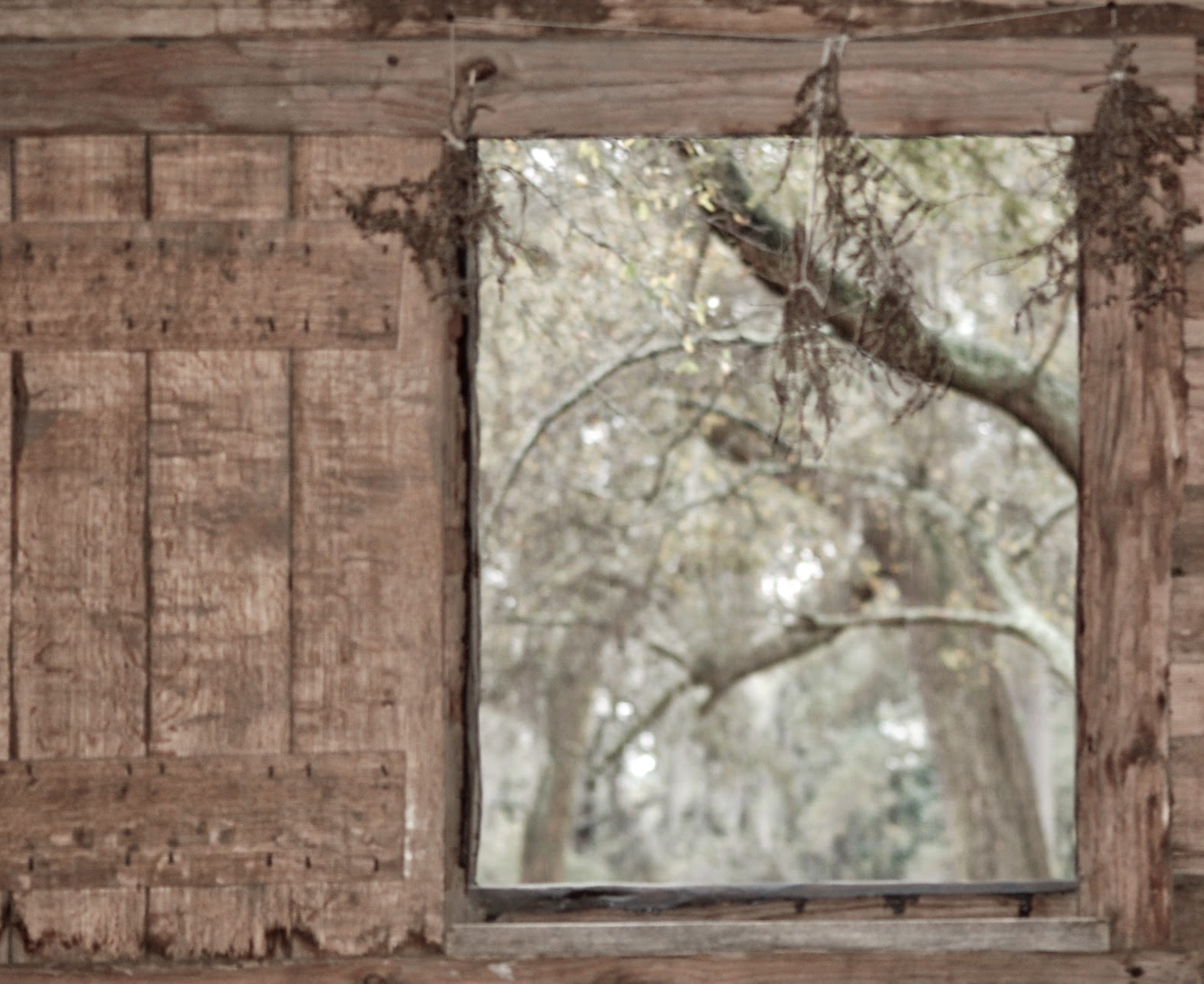
Our first stop was a log cabin. It was furnished sparsely with items settlers might have had--a blanket chest, a table, a locked trunk, and little else. There was a hammock in the loft and very little light, which I've spoiled for you by not knowing how to turn off the flash on my camera.

Log Cabin Window

770 Squire

We saw a crenelated berm with cannon pointing toward the river, a vigilant guard from a time when no trees lined the river banks and no ship could easily approach the landing. On the river we saw this replica ketch, which would have been used to move goods up and down the coast. Crewing the ketch today was this lovely lady. She's been a keeper, and so I have. And she's ever hopeful I'll turn out alright. We'll see.

Lovely Crew

The tree in the following picture is reputed to be at least 700 years old. That means it was a seedling when the Fourth Crusade began and Genghis Khan was about to invade China. You may not care about that. Certainly nobody in the vicinity of this tree at the time did. Still, it's a useful frame of reference. So, if you're feeling old, buck up. You've barely begun, my friend.

Here a While, and Not Done Yet
If you've made it this far, well done! I'll leave you with red carpet treatment of a most pleasant kind. Thank you for bearing with my rambling and reading through my prose. I'm so glad you came along with us and I wish for you many blessings and impromptu adventures of your own.


Red Carpet Treatment


Sunday, March 1, 2015

West on the Five Oh

Note: I wrote the following for a Toastmasters Ice Breaker speech. I have not delivered the speech yet, but I want to post it here anyway. If you're in the Toastmasters club and you read it here first, just act surprised. Nobody will know.


Come with me on a trip. We are going to the Midwest. We are going to my home. I'll have you know I've built some wonderfully enduring friendships just sitting and facing the same direction with people for hours on end.

From Annapolis, we’ll head west on Route 50. We’ll wiggle through Washington DC, nip through Winchester Virginia, and wind our way through the peaks and valleys of West Virginia. At Parkersburg, we’ll cross the Ohio River and enter the Buckeye State. Now it's rolling hills and farmland from Athens to Chillicothe to Cincinnati. Cincinnati--that's two Cs, three Ns, three I’s and all that's left is “at.” But we're not done. We're getting warm. We just passed through Seymour, the birthplace of John Cougar Mellencamp. Oh yeah, life goes on!

At the small town of Bedford, we’ll turn south. You’ve probably already seen parts of Bedford. Limestone from the Bedford area is part of the National Cathedral, the Biltmore estate, the Empire State building, and the Pentagon. You see, things along Route 50 travel east, too. We can't stop yet. We need to go through Shoals, famous for its Jug Rock, Luhgo-dee (it looks like it should be pronounced Loo Goo Tee, but trust me on this), Montgomery and its extensive Amish community, and finally – Washington, Indiana.

We've gone 699 miles and we are at the intersection of Routes 50 and 57. I was born here and first lived south of town in an area called Possum Holler. Possum Holler was roughly halfway between Cumback and Lickskillet. It was all back roads leading to gravel roads leading to river bottoms and it was filled with family history. My great-grandfather built the house where we lived. The family business was hybrid seed corn and purebred Angus cattle. We all attended a small Methodist Church not 3 miles away and for us shopping meant either a trip into town or an hour's travel to Evansville.

When I was 10, we moved just north of town. Our southern fence row was the city limit, so we could do outlandish things like burn our trash and not get in trouble. The new house was still old. It was built in the 1930s. I was built at the very end of the 1950s and I arrived in 1960. On my mom and dad's wedding anniversary. True story. I hope he got her a card, too.

Washington is—or was—a farming town of 12,000 people. It was a wonderful place to grow up. We could ride our bikes anywhere. We belonged. We belonged to 4-H clubs, church youth groups, Future Farmers of America chapters, community athletic teams, Cub Scouts, Brownies, Boy Scouts, Girl Scouts, the local YMCA, and to each other. In a small town, like it or not, you belong to each other.

We had our difficulties. Like traffic. In the planting or harvest season, farm equipment moving from field to field could add 10 minutes to what was already a 15-minute commute. And weather. The humid summers could make bales of alfalfa hay feel like blocks of limestone as we heaved them onto a wagon.

So I left. I'd had four years of high school French and I didn't need to be told by anybody what to do. I knew this exotic language and I was ready to travel and visit foreign lands. So, I joined the Air Force, where I got at least half of what I most wanted. It wasn't the be-my-own-boss half either. I definitely had somebody telling me what to do. Lots of somebodies, in fact. On the bright side, I visited two foreign places within my first year of service, Texas and California. Then I came to Maryland, the very end of Route 50. Here I found a series of careers. I've been a soldier, a ceramic tile salesman, a Government civilian employee, a technical writer, a copywriter, an electrician, a junk hauler, a business analyst, a manager, and some of those things several times.

Along the way, I've been a Methodist, a Mormon, a Baptist, a non-denominationalist (that's a person who doesn't like labels) and I've been fascinated in conversations with friends who are Buddhists, Muslims, atheists, or pagans. These experiences were not available on my western piece of Route 50.

I've also been a brother, a husband, a father, a son, a friend, a stranger, and that guy. You know that guy. Well, you don't know that guy, but this little chat should help resolve that. At least now you have a better idea what to ask. And please do. Be forewarned, I'd rather listen than talk. I’m predisposed to think you’re pretty interesting. But now we have a starting point for a conversation. And some of the very best relationships start with a road trip.

Sunday, January 25, 2015

How'd that Healing Happen? Outreach, Follow-Through, and the Current of the Miraculous

Is healing about complying or is it about faith? I ask because of something I heard in church today.

In the New Testament of the bible, the book of Mark relates a curious event. The New International Version gives it the heading “Jesus heals on the Sabbath.” You’ll find it in chapter 3. It goes like this:

Another time Jesus went into the synagogue, and a man with a shriveled hand was there. Some of them [Pharisees] were looking for a reason to accuse Jesus, so they watched him closely to see if he would heal him on the Sabbath. Jesus said to the man with the shriveled hand, “Stand up in front of everyone.”
Then Jesus asked them, “Which is lawful on the Sabbath: to do good or to do evil, to save life or to kill?” But they remained silent.
He looked around at them in anger and, deeply distressed at their stubborn hearts, said to the man, “Stretch out your hand.” He stretched it out, and his hand was completely restored.

As the story was shared with me, the teller hit the expected high points.
  • The Pharisees, considered paragons of righteousness by their peers in 1st-century Israel, in this story gave rules precedence over compassion.
  • Jesus—the very gentle Jesus we are taught about—got angry.
  • Sometimes it is more appropriate to break the rules than to color within the lines.


Where I got curious was in the last sentence, “He stretched it out, and his hand was completely restored.” What was the order of events here?

Jump into the story. Think about it. Suppose you’re a man with a shriveled hand and you went to Sabbath service. This guy shows up at the same service. And off to one side you see a group of guys you really respect. They’re kind of a big deal, you know? And they’re looking at you. They don’t usually do that. It kind of makes you uncomfortable. Folks read more into your shriveled hand than they ought to. Like it’s a curse or something. So staring and whispering are not unusual, but they’re not comfortable.

The group is also looking at this other guy. He’s a traveling teacher who doesn’t always come to this service. He has a reputation for doing hard-to-believe things. Healings. Not today, of course. It’s Sabbath. But he could if he wanted to. He knows they’re watching. You get the idea he’s used to being stared at too.

The teacher is now looking at you as well. Everybody is looking at you. You wish you could just quietly leave, but they’re all between you and the exit. The teacher asks you to stand up in front of everybody. Every body. It was uncomfortable before, but it’s almost unbearable now. He’s looking into your eyes, but talking to the group that had been watching you. “Which is lawful on the Sabbath: to do good or to do evil, to save life or to kill?” he asked them. Suddenly it was very quiet. Nobody said anything, and that seemed to tick off the teacher. He looked back at you again and said, “Stretch out your hand.” So you stretched out your hand and …

[Freeze frame]

Something incredible is happening. It may have been just now or it may be in the next millisecond. It’s not the proper time, of course, but it’s happening anyway.

I asked a friend today what she thought the order of events was. How do you think it happened?

The teacher asked you to stretch out your hand just now and you did. What were you thinking? Perhaps “This is not going to end well.” Or maybe, “Oh, boy! This isn’t supposed to happen on a day like today, but I think I’m about to be healed. Me! I’m in. Let’s do this.”

Did you reach out and see your misshapen hand being replaced with healthy sinews? Or did you reach out in response to his command, amazed to see a well-formed hand at the end of your arm even as you stretched toward the teacher?

What's it matter? I think there is a significance to the order of events. It won’t change the rotation of the earth or change the seasons, but it could change your life or mine if we embrace it.

In my opinion, the healing preceded the act of reaching out. But it didn’t become visible before the outreach happened.

Follow-through. Think of outreach like the follow-through in an athletic event. If you stop short when hitting or throwing a ball, you’ll probably get a substandard outcome. You need to commit to the action and follow through to hit your target.

When that rabbi said, “Stand up in front of everyone.” you knew what could happen. You embraced the possibility of a miracle. You were primed for something. You mentally prepared yourself to become the manifestation of a good work. You weren’t sure what it would look like. Maybe you would gain a little range of motion. Maybe your hand would just straighten out a bit. Who knew? What you did know was that you’d heard good things about this guy, so you were at least in a “Why not?” frame of mind.

So I believe the healing occurred internally, then became visible when the man responded by reaching out. If you need a basis for this opinion, think about people in your sphere of influence. Have you ever seen a need and tried to meet it? You set things in motion to make things work out for somebody, but they fumbled it because they didn’t believe it could happen for them. They’d become accustomed to less than optimal results and it had become their expectation. It’s the outreach principle in reverse.

Belief is a switch in a really big circuit. None of what I’ve shared considers who this teacher was. A miracle must have a source, but that’s another story. The point I want to make is that we have a role in the miracles we experience. Think of it like electricity.

When you walk into a room and turn on the lights, electrons from a current source flow in a closed path called an electric circuit. The light switch can control circuit, and has one of two states: either "closed", meaning the contacts are touching and electricity can flow between them, or "open", meaning the contacts are separated and the switch is nonconducting.

If blessings and miracles were an electrical current, is your switch open, so all the blessings stop short of you? Or is your switch closed, completing some supernatural circuit and accepting—even expecting—the flow of good things into your life? Maybe it's time to stand up in front of everybody and reach out.


Sunday, January 26, 2014

Ringing Cosmic Doorbells

In a monotheistic worldview, there is only one god. Despite that perspective, we say, “my god.” It is a much more loaded phrase than “our god.” It infers that there may be a “your god” that is not “my god.”

Well, that won’t do. Human nature is not kind when presented with choices. We don’t simply select. We justify to prove the superiority of our selection. In this case, it begins with a subtle distinction. We say “my God,” but “your god.”

So calling “my God” now sets the stage for a cosmic challenge in which my obviously superior god will best yours in any contest declared. If we are children of the god(s), it calls out our parents to defend their titles. Since we’re kids, we can reasonably assume it calls them out to do it right now. Any self-respecting god must show up.

From a deity's perspective, I imagine this expectation is burden enough when simply verbalized. There is an immediacy and vibrancy to the spoken word. Certain religious texts inform us that the spoken world is what got this present reality rolling in the first place. But there are other ways to communicate. What about when we write it down? Or when we type it? Can you see where this is going?

Enter the phrase known in the phonetic alphabet as Oscar Mike Golf. By reducing the phrase “O, My God” to three simple letters, we’ve set ourselves up. Beware what you type. When God or god becomes “G” or “g,” we easily forget who or what we are addressing. But we still call. We ring the doorbell. We’re not pranking. It’s more like operating in a fog. We press the button, then we walk away with no expectation that there will be an answer. We don’t even remember asking for one. Despite that, the next time we beckon, we fully expect the Deity of Our Persuasion to respond with alacrity. The phonetic alphabet for that call is Whisky Oscar Lima Foxtrot.


Monday, September 2, 2013

Mind your Zs and Qs?

What does it cost to save? I was playing an online word game with a friend this morning and was faced with a tray full of vowels and a lone Z. Normally, I'll wait to do something spectacular with a weighty letter such as this. This morning though, I opted to play it quickly. My strategy changed. And I thought I'd share just why.

There is space in the letter tray for seven letters. No more. Just seven. So while I'm waiting to be spectacular, there actually is space in the tray for only six letters. Imagine if I had the Q or the X as well as the Z. I would have cut my potential for change by 42 percent. And change equals opportunity.

Admittedly, the reward for saving and waiting can be significant. Using the game example, imagine aligning a Q or a Z, each worth at least 10 points in the games I most often play, with a Triple Letter Score or Triple Word Score space on the playing board. If the opportunity to apply that bonus in two directions presents itself, the benefit may be 60 points or more.

Here' the balance. How many 5-10-point words are you willing to play to set up the big score? How many plays that might exceed 20 points are you willing to forgo to be spectacular? Because while you're waiting, you're reducing the opportunity for new letters to flow through your tray. And large payoffs can have large costs. Ask anybody who has been left holding a Q at the end of a game.

The repercussions of misplaying a game are slight. I have not been invited to any high stakes word games and I'm not expecting such an invitation. You win a couple, lose a few, and keep on playing. It's a diversion.

When I pull my gaze away from the monitor, though, and look around the room, the principle still applies. I see a lot of items I've clung to for quite a while. Having moved a few times in the past few years, I know their cost in packing and labor. One does not heft a box full of vinyl records, for example, without questioning their value in enjoyment when compared to the effort required to carry them up and down flights of stairs. My home is full of such things. If I were to be asked to drop everything and move to a new place doing the work of my dreams, today I would say no because of the practical requirement to pack, load, ship, receive, unpack, and situate my belongings. My Zs and Qs--and truthfully, my Fs, Ms and Bs--anchor me here. And not in a good way.

What is the purpose of playing? Is it to be spectacular or to win the game? I think it is to win. Let's move a step further away from the computer monitor and cross the threshold of our front door. What does the game look like out here? What are the Zs and Qs in our professions or in our relationships? Do we hold things tightly because they are comfortable rather than valuable? Because they are known, despite their condition?

Recently, I was looking at a book filled with pictures of small living spaces. I've lived through a period when so many people embraced larger homes and I still enjoy looking at beautiful designs of estate homes. The thing that most impressed me about the small home designs, though, was the simplicity of lines, the lack of clutter, and the willingness to live with less. I confess, some of the photos left me unmoved. They were too stark for my taste and I didn't feel as if people were living in those spaces. At least not happy people. But I was curious what it would be like to successfully accommodate my belongings in a dramatically diminished footprint and still have all I need. My wife and I have made a huge step in that direction. Our home today is much smaller than our former home. We've been here a couple of years now and we're still facing the issues of clutter, proportion of items to the spaces they occupy, and getting the best use from the rooms we have. But we've begun.

I don't know where the balance is in this. I don't feel we have the agility to respond to a life-altering opportunity today. That's sad, really. On the other hand, we have quite a few belongings that bring us comfort. Are they Qs and Zs?

I'm tempted at times to empty the tray entirely. What if? What if we had no possessions and no ties to our current jobs? Would we stay here? Would we look for the same type of work? Would we make a difference in other people's lives? Would it be more or less than we do today?

I don't expect an answer to these questions, but I'd sure like to play at least some of the big letters and make room for change. How about you?

Wednesday, August 14, 2013

Beendorsedments

LinkedIn has turned self-promotion into an industry with its "endorsements." If you're a LinkedIn member, you've probably seen these. A message appears in your inbox telling you that one of the people in your network has endorsed you for a certain skill. That is pleasant and affirming, but potentially misleading as well. These endorsements have the same reputability as a certain online encyclopedia compiled and maintained by the community-at-large.

I enjoy recognition as much as the next person. The part of this process I dislike is that I have little control over the endorsements I receive, which of my skills is being endorsed, or the authority of the person doing the endorsing. I've not looked deeply into the LinkedIn mechanism for endorsements, but if what I saw over my wife's shoulder is anything to judge by, one is presented with several pictures, each a person from one's network, and a word or two. Does Jan know about Corporate Law? Does Samuel know about Botany? Does David know about Accounting?

All well and good, but here's the trap. Suppose Accounting appears in my resume simply because I performed that function in a limited capacity several jobs ago and I dared not show a gap in employment? And now, my close personal friend whom I know only in passing because we ate in the same dining facility at yet another job, has endorsed  me for my capacity to work with numbers. I understand. They were simply trying to be helpful, but do they realize that they may have consigned me to a small, stifling corner of Hell? I begin receiving notifications of employment opportunities spending my day with numbers. Jobs where I would look wistfully across the office at the copywriters and editors, aching to describe something or even to document a process. But then, it is back to columns and rows, rows and columns.

The die is cast. Around the world, people are boredly staring at their monitors, bunching one cheek into a contorted caricature of themselves with an arm and a palm for support as their glazed eyes consider the rogue's gallery of contacts being paraded before them. And they are clicking. Yes. No. Yes. Yes. No. It's like a poor person's version of a slot machine, but the payout is an email informing the person behind the photograph that they have been honored by yet another endorsement with little or no basis.

I ask only this. If you're a LinkedIn member, resist. Don't go for the easy click and the illusion that you've thoughtfully considered their aptitude, and that you approve. Save your unreserved support of somebody's capability for that select group of people whom you've seen in action. Repeatedly. The people you'd not hesitate to tap if you were forming a team. The people that you know you'd be proud to stand behind at any time because they have not only talent, but character. Every endorsement carries a little bit of you, too. Make it count.