Monday, March 13, 2017

Do You Have Game?

Several years ago I got immersed in a first-person shooter video game. Sucked in. I gave it my time. My energy. My thoughts. When I wasn’t playing, I was waiting to play. When I sat in front of the computer, two hours would pass incredibly quickly. It was a rush.


Video games are fun. There are some things that you can’t do, though. If you turn where a wall is, you can’t go through the wall. You know the room you want is on the other side of the wall, but you have to go all the way around. Do you know why? It’s not your game.

You may play the game. You may have bought it, but it’s not your game. You can’t turn and enter that room because the code the game is written in won’t let you. As long as you play that game you’ll be limited by another person’s imagination or their purpose.

Do you want to play somebody else’s game? Here’s a better question. What would your game look like? Where would you set the limits?


Feel free to apply these questions to the rest of your life.

Friday, February 3, 2017

Keep an Eye on the Neighbor

Went to see D’s family this evening. I wish I’d known him better. I learned he was very bright (knowing his family, I figured as much). He was skilled mechanically, worked several jobs where he used his hands, including keeping a carnival running. He was funny. And he was loved as a son and a brother. His family amassed a sizable tribute in framed photographs, showing a number of activities they’d done together. From the smiles, you could tell they were good times.  
I can’t imagine — nor do I care to — what it feels like to lose a sibling. Just today I reached out to my older sister. It felt so good to hear her voice, to make her laugh, and to make plans. To have that taken away is inevitable, but sad. I’m sure the feeling will be much stronger for whomever remains when one of us moves on.  
I think Death looks different as we spend more time with it. At first, it hardly exists. We are in awe and something like horror or terror when it visits us. 
Later, we pretend it does not exist. We are immortal. Wise. On the early side of twenty. Then, death. “Look away. That is not for us. It happens to other people.”  
We learn to abstract it. It’s simply a harvest of the old, the feeble, the incurably ill. And it’s not fair. It comes other ways, but we’ll not think of those.  
Next, Death becomes like a bright, white Volkswagen Beetle. You don’t see either until you look for it, then you realize it is more common than you expected.  
Soon, Death becomes the obnoxious neighbor who crashes all your cookouts and you wish you didn’t grill out every week. But you can’t stop.  
Eventually, I suppose each of us makes friends with that neighbor and learns he or she can take us to places we’ve never imagined. Or weren’t ready to visit. Today, I just want to be aware enough to slip out the front door as the neighbor is coming through the back gate. We can strike up our friendship later.

Wednesday, January 25, 2017

Texas No. 7 -- Aransas Pass & the Final Resting Place


I am attracted by history. When I’m driving, if I have no place to be at a certain time, I’m likely to follow signs to historical markers. One such sign in Aransas Pass led me to Cementerio San Antonio de Padua. I turned off Route 35 onto Cemetery Road, a gravel roadway, and looked for the historical marker.

The marker has an emblem labeled “Texas Historical Commission” at the top. It reads:

CEMENTERIO SAN ANTONIO DE PADUAAccording to local lore, George Lewis (1859-1895) donated one-half acre of land at this site to the Hispanic citizens of the area for use as a cemetery, provided that he be buried in the center of the land. Handmade stones indicate burials dating from the 19th century; the first recorded deed was signed in 1933. Years of wind and rain have rendered many stones illegible. A number of children who died in an influenza epidemic in 1940 and many veterans of U.S. and international conflicts are interred here. A statue of San Antonio holding a child, crafted in Mexico, was brought across the border by the local priest for placement in an open chapel on the cemetery grounds. It is revered by the families of those interred here. (1998)”


Historical marker for Cementerio San Antonio de Padua


You can’t help but feel how personal this space is. In fact, it’s a gathering of many smaller personal spaces. Stones or a cement curbing neatly mark the boundaries of each family’s plot. The curbs and stones are often painted white and the graves are neatly kept. A wire fence with a gate encloses a grouping of several graves. The family name is on a sign at the gate.

Most of the plots have a stone bench, evidence that family members intend to visit and stay in touch.
As the marker says, there is a central, open chapel. The statue of San Antonio is shielded by plexiglass today, but stands on the altar flanked by two lamps on a white latticework wall. A small American flag of the type you would wave in a parade shifts in the breeze, tucked between the wall and Saint Anthony’s protective case.

Statue of San Antonio de Padua

With only a few exceptions, most notably, Mr. Lewis, the names reflect the Hispanic heritage of the site: Ancira, Aquirre, Benavides, Calvillo, Castro, Cortez, Davilo, de Leon, Elizondo, Escamilla, Fuentes, Garcia, Gonzalez, Herrera, Longoria, Lucio, Marquez, Mendoza, Mireles, Moreno, Novela, Ortiz, Palacios, Robles, Rodriguez, Ruiz, Soto, Torres, Trevino, and Zamarripa.

Several are World War II veterans, one served in in Viet Nam, and another was killed in Afganistan. The latest date I noticed was 2011. It pleased me that such a historic place was still being used today and that families were taking the time to visit and honor their ancestors.

Texas No. 6 -- Mustang Island


Before I even visited Texas, I heard about Mustang Island. The person telling me about it spoke the name as if it was something special. It turns out it is. In an area where marshy areas dominate the landscape, the island offers a real beach. It has specific habitats. It hosts a variety of wildlife. It ..., well, let's let Texas explain:

“Mustang Island, Texas is an 18-mile-long barrier island located between Corpus Christi and the Gulf of Mexico. It features a continuous line of stable sand dunes. Dunes are created through the action of waves, tides, and wind-blown sand. Vegetation is critical to dune stability. It anchors the dune and catches wind-blown sand. Dunes act as a buffer against wave damage during storms. Barrier beaches, dunes, and vegetated barrier flats provide a unique habitat for a wide variety of pants and animals.”

Aransas Pass and Corpus Christi both claim parts of Mustang Island. The Aransas Pass end, the northern part of the island, has a variety of home styles, RV parks, a satellite campus of University of Texas that specializes in aquatic science, and a beach that you can drive on. The Corpus Christi end has a state park and a variety of vacation rental options near the beach. It also has a bridge.


The bridge is an important point, because Aransas Pass has no bridge. It has a state-operated ferry service. Four lanes of traffic drive onto one of several ferries and cross the narrow channel.
Signage at the UT …. Tells the story.


“The Aransas Pass Ship Channel serves two vital and harmonious roles for the Coastal Bend of South Texas. It enables water-borne commerce that is essential to the economy and exchange of water with the Gulf that is necessary for healthy bay. Water-borne commerce through this channel dates to the early 1800s. Today, it allows transportation of oil, petroleum products, offshore oil exploration equipment, dry/bulk cargo, and military transport to and from the Port of Corpus Christi. The Aransas Pass Ship Channel is the economic engine that drives much of the State’s economy.”

I saw all of the preceding on Mustang Island, as well as salt marshes, tourist attractions, restaurants, and outfitters. The outfitters were there to gear anglers and to keep dollars on the island. Costa sunglasses ranged from $100-250. Jackets from $70-170. I’m sure it was all good stuff, but I know people returned from Mexico with sunglasses they cheekily called “Fauxkleys” for $15 per pair.
My first trip to the island was just to get the feel of the place. I drove on the sand beach, explored a couple of RV parks, and looked at the architecture.

One of the most interesting places I stopped was a nature preserve. Decked walkways crossed wetlands and wide gravel paths wound through the area. They led to observation platforms that helped you get a sense for the landscape.

Marsh Grasses

Development Beside the Wetlands

Water Plants

Fire Ants


My second trip began eerily. There was a heavy fog that morning. During the ferry crossing, I could only see bright lights on the other side. All else was hidden. I found a 50% discount on golf cart rental and purchased a four-hour block. Driving down the beach in the cart was chilly and damp. Visibility was low and the wind was blowing. Fog condensed on the roof of the cart and dripped into my face as I drove.


I ventured toward the western side of the island where sun was burning through the clouds. It was warmer and safer. After lunch, I returned to the beach side and saw things I’d passed in the fog without even noticing they were there.

My third trip to the island brought home the reality of wind-blown sand. It was January 22 and Panama City, Florida was reporting gale-force winds and 6-9-foot waves in the Gulf. Can you guess where their wind comes from? It was still breezy here on the Texas Coast. So much so that a drive down the beach did not invite leaving the truck. Nor did the drive to the northern tip of the island to boat watch.

Wind blowing up the channel created whitecaps. Huge boats entering the channel hugged the inside of the lane, just in case. Oil tankers are not particularly aerodynamic and they wanted to give themselves room to be pushed around. Fine sand grains blasted the side of the truck and anything else in their path. Anybody outside was made miserable.

I went to the edge of the sand area, tucked between the seawall and sand dunes. As mentioned above, vegetation plays an important role in keeping the sand on the ground and protecting against the force of the wind. It was calm, sunny, and comfortable in that area.

On the mainland side of the Aransas Pass Ship Channel, oil platforms are brought in for maintenance.  These two stand side-by-side and you don't appreciate their scale until you see a full-size pickup truck parked at the foot of one. 

A bridge crosses a pond at the UT educational complex.

If you're from southern Indiana, it may seem like redwing blackbirds are everywhere during the summer. In particular, I see them in the tall grass that lines many rural roads. In the winter, they're gone. They fly south, like so many people's grandparents. I've wondered where they go. I can't speak for all of them, but quite a few were flying around one very windy day on the north end of Mustang Island.

These two were flying about with a murder (I looked that up — I thought it only pertained to crows). Here they have settled for a moment on the gate of a private pier belonging to a University of Texas educational facility.

It was a particularly blustery day. Over the Aransas Pass channel, pelicans were having a difficult time making any headway. Some gave up, settled in the choppy water and decided to paddle instead. Being lighter and more agile, these two and their murder made several aerobatic passes before settling. At one time more than a dozen clung to this barbed wire between brief flights over the area.

Redwing blackbirds grip the wire on a blustery day.

Spiny succulent blades in the afternoon sun.


Cactus spines.

Two divers surfaced as I walked along the seawall. That was surprising.


Texas Gulf Facts

  • The Texas Coast is approximately 375 miles long, from Sabine Pass to Brazos Santiago Pass
  • The Texas Coast is on the northwest portion of the Gulf of Mexico
  • The Texas mainland is protected by an almost continuous string of sand barrier islands
  • This arc-shaped coastline and the string of barrier islands were created by winds, which blow out of the southeast for approximately nine months each year
  • Southeast winds create longshore currents which converge off North Padre Island
  • Currents move sand to this area, south from Galveston and north from San Padre Island
  • Padre Island is one of the longest barrier islands in the world
  • Passes between the barrier islands allow bay water to exchange with Gulf of Mexico water


Texas No. 5 --- Rockport

Rockport

Whatever your thoughts of Texas may be, Rockport is probably different. My first introduction to Texas was August in San Antonio. It’s not a fair first impression. I was herded from one place to another, had my head shaved, was issued clothing and gear, and kept from polite society for six weeks. To me, Texas was too large when marching or running. It was too hot, period. It was too new and it was not soon enough when I said goodbye.
I returned a year later for a month in San Angelo. Texas in September on the Edwards Plateau was hot, dry, and dusty. The steaks were huge. The river was muddy. And what didn’t want to bite you wanted to poke you.
Rockport is much more in the vein of Florida and other coastal states. The ground is sandy, and supports patches of tough grasses. Some grasses sprawl and others clump, making homes for wildlife. Burrs do well here and seem as pleased to ride on socks and pant legs as they are to attach themselves to animals. There is often a breeze and the smell of the water is unmistakable as you draw near the coast.
There are lots of bay views. There are rocky beaches. Along the water, egrets, pelicans, seagulls and pigeons gather. Diving birds tilt and disappear, rising several feet away.

Bird Life
  

Rockport is home to fishermen, both professional and amateur. The shoreline is dotted with marinas that hold a mix of working boats and pleasure craft. Bait shops anchor many of the piers.

Public Pier

Working boats tie up near the more commercial bait shops and get their supplies before they go out each days. There are two types of shrimpers. Bay shrimpers go out and come in daily. Ocean shrimpers go out for several weeks at a time. It's not an easy life. Then again, Texas in some respects is not an easy place to be.
Aransas Bait Co. 

The variety of home styles is interesting. Quite a few people live in trailers. Some in trailer parks or RV parks, but many on larger pieces of property where the trailer is the main dwelling. There are smaller homes that are well kept. There are smaller homes that are overgrown. Plant life along the Texas Coast is tenacious. If you're working hard all day long, all the fight may have gone out of you before you get home and decide to wrestle with vines and thorns. There are also larger, nicer homes in enclaves near the water. 


Wealth can purchase a lovely view. But there is a price. The pier in the following picture has endured intense sun, salty breezes, and quite a few storms. The homes that cluster along the edge of the bay get the same brutal treatment. Even if you have the money to purchase a home (a modest, unpainted, elevated home just behind the dunes on Mustang Island listed for $1.2 million), make sure you've budgeted for the necessary maintenance.

Weathered Pier

Since it is home to so many Winter Texans, Rockport has created an enviable quality of place. There are a number and variety of eateries. Many of them are devoted to breakfast and lunch trade, closing around 2 p.m. Without visiting any chain restaurant, you could enjoy barbecue with tender brisket slices, Maryland crab cakes (a welcomed transplant called 495 East), steakhouses, Mexican dishes, and quite a few donut parlors. 

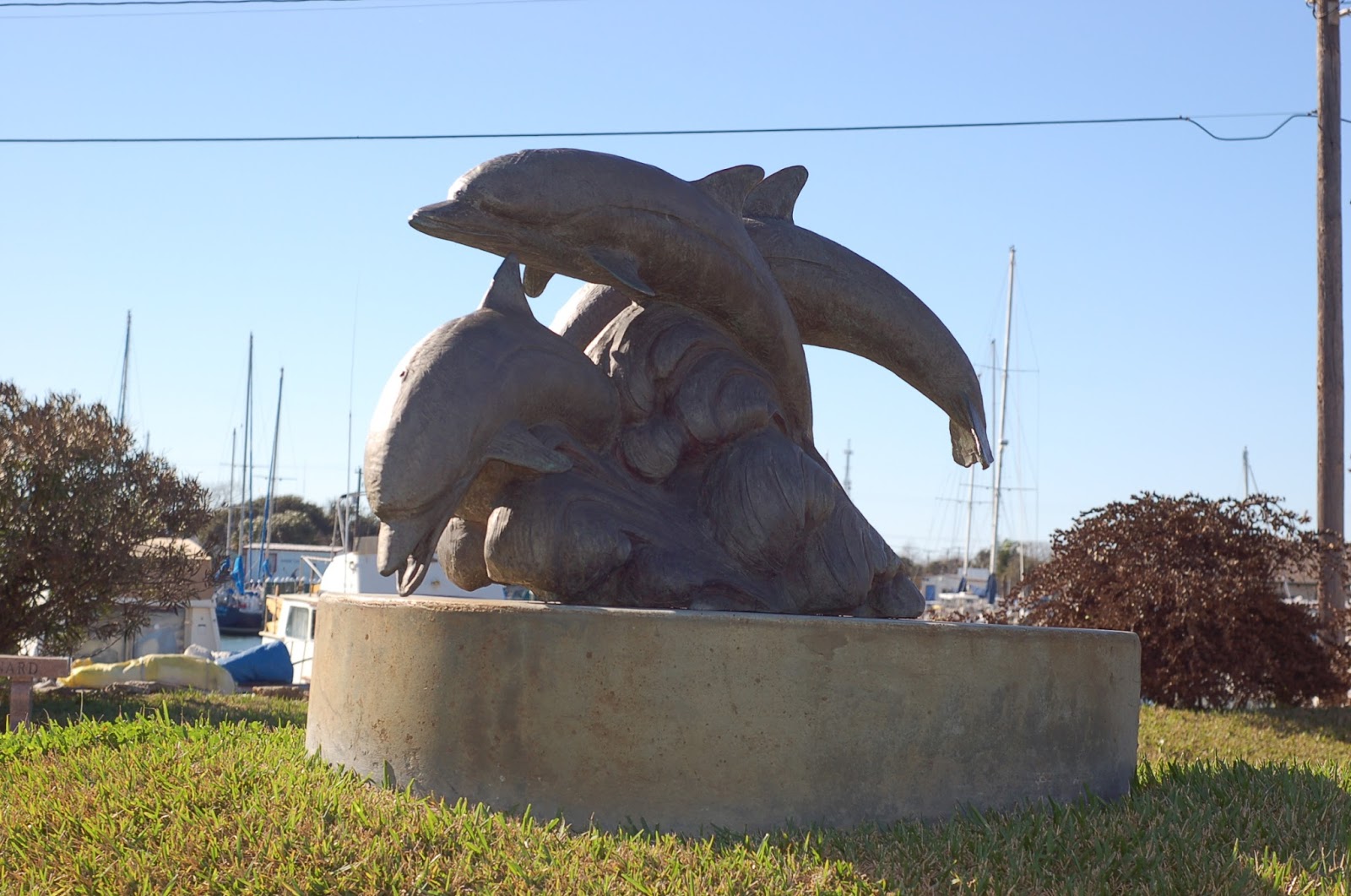
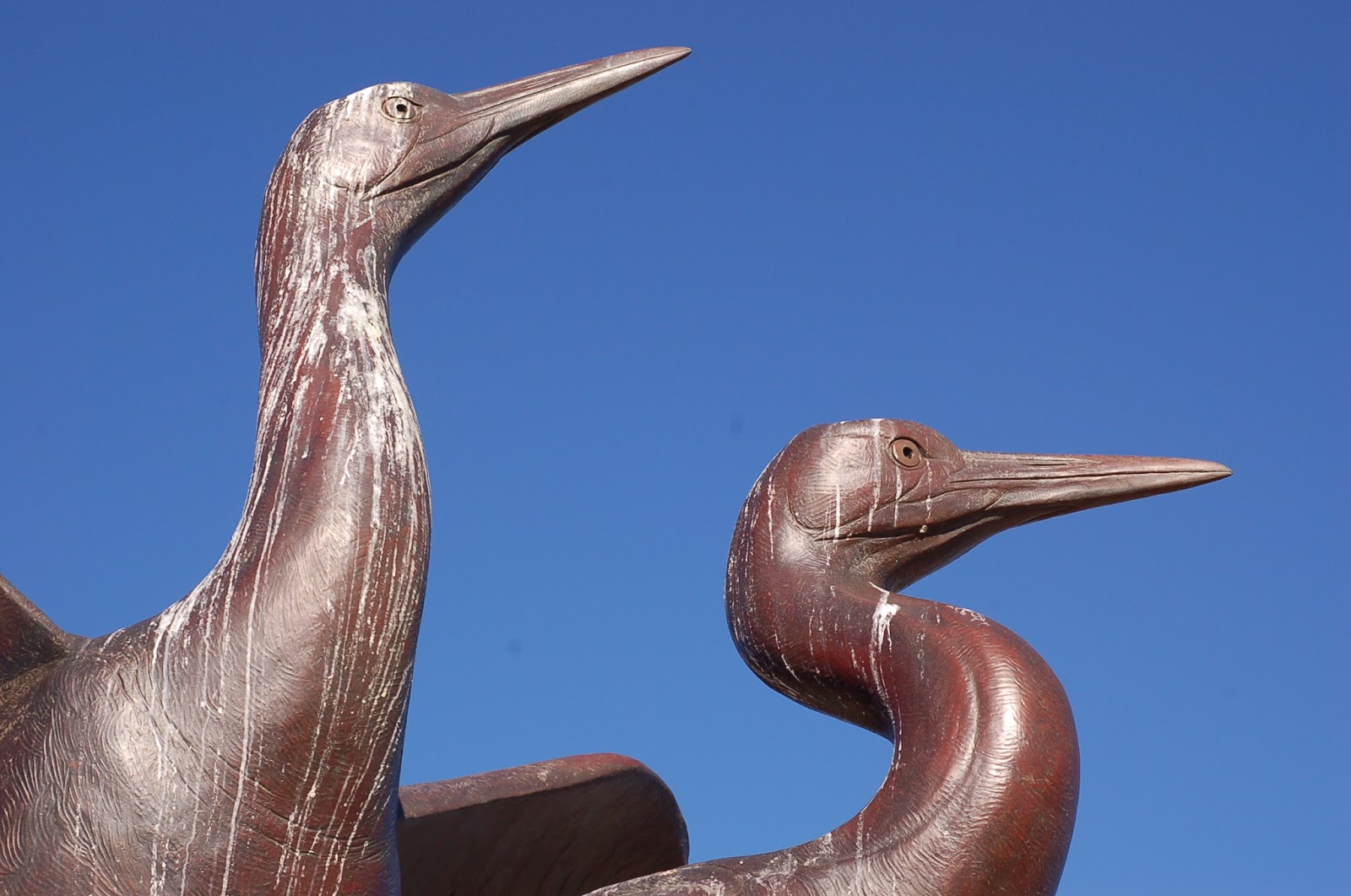
People have an appreciation for art and color. Like makeup, the color requires frequent application to remain attractive, but bronze shows impressive endurance. Near the aquarium and Rockport Harbor, the town has erected several bronze sculptures in a garden, including porpoises, a turtle, a woman waiting for her sailor to return, and two birds.

Off Port Bow
Rites of Spring

Into the Wind

Off Port Bow

Rites of Spring
Man's Best Friend

If you're heading to Texas and you're near Corpus Christi, swing wide and give Rockport a try. It was a wonderful place to relax with friends.

Sunday, January 22, 2017

Texas No. 4 - Connectors & 'The Ranch'

Connectors
Would you like to know why the Circle W is my Texas home today? It’s because my friends Deb and Ron are connectors. I don’t think it’s intentional. It’s just who they are. People like them. People want to be with them. And they take very good care of their friends. 

Deb wants to find activities people will enjoy. Then she makes them happen. Ron is a good man who has seen a lot and doesn’t get flustered easily. He has a great sense of humor and likes to fish.

That’s kind of the vicious cycle of retirement, from what I can tell. Get up. Drink the coffee. Go out to breakfast. Come back. Have more coffee. Go fishing. Walk the dog. Maybe fish a little more. Sit around the trailer with friends. Have another coffee—or maybe a beer this time. Go fishing. Let’s eat! Sit around the trailer.

If that sounds boring, you probably haven’t met the right people yet. Deb and Ron have attracted a group that has become their winter family. So much so that when the couple came to Rockport, their friends followed them. What’s another hour and a half when you’ve just traveled 20 hours or more to get here?

And people do travel! Walking around the RV park I see license tags from Indiana, Michigan, Colorado, California, Arkansas, Washington, and even other parts of Texas—which may or may not be nearby. In Texas, “near” is a term even more subjective than it is elsewhere.

I found it interesting that three of four couples I interviewed had been farmers. It makes sense that someone who has spent their career in stewardship of the land would find spontaneous travel an appealing form of retirement. But that's a stretch, because people aren't just picking up and going all the time. They are finding connection with a group and spending time together.

Speaking of travel, I asked folks about their favorite spots. South Dakota and Colorado were two states mentioned. The Dakota fans liked that it began as flat land, then became hillier as they went west. They liked the variety.

Colorado was described the same way. It's easy to think of Colorado as mountains, since that is a significant feature of their license plate, but the state is also plains and foothills. It was the dramatic slopes and lakes that were favorites of the person I talked to.

Another area that people particularly liked was the Smoky Mountains and the Blue Ridge Parkway. I've traveled the Skyline Drive portion of this route and I agree that it is particularly attractive. It is also near the Shenandoah Valley and within fairly easy driving of several East Coast cities that offer a variety of entertainment options.

Meanwhile, back at ‘The Ranch’

Deb looked at several locations in the area, but decided on Circle W RV Ranch. The facility is under new management and boasts an array of amenities: indoor pool, wifi throughout the park, cable television, onsite laundry facilities, exercise room, mail room, a billiards parlor (four tables, no waiting), and a large open room where residents gather for meals, celebrations, and games. It’s affordable and continues to attract “winter Texans” year after year. 

Anyone here will attest that the roads could stand updating (which reportedly is in the works), but they are drawn by the hospitality of staff and just because they like their neighbors. Rockport, Aransas Pass and Corpus Christi are all easy drives. Groups from here even drive three hours to Progreso Nuevo, Mexico once a month.

If you visit, here’s some of what you’ll see:

Ponds …


… palms, …


… the pool …


... and pointers.


If you're in the neighborhood, drop by. You'll find Hoosier hospitality with a Texas twist. And very likely a fresh cup of coffee, too.


Saturday, January 21, 2017

Texas No. 3 - Names and Observations

All along my route I enjoyed poetic names like Burnt Prairie or Ullin, Illinois; Portageville and Hayti, Missouri; and Luxora, Amanca, and Okilona, Arkansas. I was and still am curious about their origins. Portageville is built on a sweeping bend of a river. That could be a clue. They others remain mysteries at the moment. Research challenges to be acted upon at another time.

The earth in Arkansas becomes noticeably darker than in the tilled fields of Illinois and Missouri. Where some communities have heavily invested in the tubes, guy lines, angles, and wheels of pivot irrigation systems, Arkansas appeared differently. There the ground seemed impermeable. It may have been saturated with rain from prior storms. It may have been too sticky to percolate and let the water into where it would do the most good. I saw low-lying fields that could as easily have been small lakes or rice paddies. All one could see for acres and acres was the surface of the water covering the ground.

Two cities seemed bashful. I thought West Memphis, Arkansas would never appear over the horizon. I know the numbers went down on signs announcing remaining miles to travel, but they went down so slowly! It seemed time or distance had frozen since the last sign. Texarkana Arkansas/Texas also seemed reluctant to appear.

Finally, Texas. My first surprise was speed limits. The posted speed limit was 75 mph. This was on divided highways, then four-lane roads on which the median was an area of asphalt set off by yellow reflectors. It wasn’t interstates. Anybody leaving their driveway along a similarly posted stretch of road would need to get up to 75 mph nearly instantly. I wondered what it was like for teenagers to negotiate the turns of that road. It was foggy as I traveled. Parts of the road were soaked in a drenching rain. Still, the posted speed limits were 70-75 mph.

Houston, Texas sprawls. The Greater Houston Metropolitan Area was 50 miles of major roads. It’s not too bad at 3 a.m., but it’s no place to pull a trailer during rush hour.

My friends used to set up at an RV resort in Palacios, Texas. Rockport is 80 miles further south, nestled between Fulton and Aransas Pass. If you can read “Aransas” and not want to throw a k in there to make it look right, you’re not alone. While I am here, I’m making the Circle W RV Ranch my home.