Tuesday, March 24, 2020

Georgia: What Two Guys Won’t Get Up To

A Five-Day Round Trip to Georgia for Family and Cattle

THURSDAY -- “This is the stupidest thing you’ve done in our entire marriage.” My traveling companion shared this opinion from his spouse as we headed southeast. My own dear wife was similarly impressed by our decision to keep life as it was scheduled before the contagion. So was my younger sister, who made her opinion clear from her home in Greece.

When three grown women on two continents are in such accord, one must proceed with the utmost trepidation. So we did. We were going to a cattle sale.

Our destination was the 32nd Partners in Progress Hereford, Angus and Baldy Female Sale being put on by CES Hereford and Angus and Predestined Cattle Company in Wadley, Georgia.

Proud Addition to My Cap Collection. 


CES is owned and operated by Mr. Charles E. Smith, usually addressed as Mr. Charles. He is a southern gentleman, a successful farmer, and a strong Christian man.

Predestined Cattle Company is Kyle and Jennifer Gillooly. Jennifer is Mr. Charles’ granddaughter. Kyle is my cousin. He has worked for several years helping Mr. Charles improve his herd and has also worked to build the herd that he and Jennifer own jointly. Both of them are committed Christians, hard-working people, and just about as nice as folks can be.

This year was different than other years. The entire United States was contracting like a sphincter as it attempted to contain the Coronavirus (COVID-19). We were uncertain how it would affect travel, lodgings, and meals, but we determined not to miss this annual sale as long as it was still being held.

We left southern Indiana on an overcast day, driving through heavy rain around Evansville as we crossed into Kentucky.

We were not alone on the road. Truckers continued to ensure goods made their way to market. People in private vehicles still moved along toward their destinations, although many fewer than there might have been. Urgings to stay at home seemed to be working.

We stopped only at rest areas for necessary breaks and information until lunchtime in Tennessee. Hearing that traffic would be unfriendly on the way to Chattanooga, we opted to go through Birmingham, Alabama.

Cracker Barrel

Around Columbia, Tennessee, we found an open Cracker Barrel restaurant. A luxury. Hoosier restaurants had been forced into walk-up only status earlier in the week. They could cook. You could eat. But not on the premises. Even my favorite coffee shop pleasantly greeted you at the door, which was blocked by a heavy table, and passed your order to you.

The Cracker Barrel folks had made accommodations. The menu was a single page of paper. In our section, only three tables were occupied and each party was seated far from the others. Beyond that, the service was fine, the food was done well, and the staff was friendly. It was just as normal as an abnormal day could get.

Rest Stop Rocket

Entering Alabama, we stopped at the rest area. Same reasons as before. This rest area was hard to miss. Proud? You bet your sweet astronaut!

Alabama Welcome Center, Elkmont


When we think of space flight, Kennedy Space Center at Cape Canaveral, Florida is famous for its launches. The Lyndon B. Johnson Space Center in Houston, Texas is famous for its Mission Control Center. Alabama has bragging rights too. NASA's Marshall Space Flight Center is situated on the U.S. Army's Redstone Arsenal in Huntsville, Alabama.

According to NASA's website, "For more than six decades, NASA and the nation have relied on Marshall Space Flight Center in Huntsville, Alabama, to deliver its most vital propulsion systems and hardware, flagship launch vehicles, world-class space systems, state-of-the-art engineering technologies and cutting-edge science and research projects and solutions." And that's why it's difficult to pass the Alabama Welcome Center in Elkmont, Alabama without craning your neck and being surprised by just how tall a rocket really is.

Things became more congested around Nashville, Birmingham, and Atlanta. We stopped for the evening in Conyers, Georgia, east of Atlanta.

Colberts in Conyers

We spent the night in a Hampton Inn. They provided written descriptions of the extraordinary steps they’d taken to ensure the safety of their guests. The next morning, except for a lone lodger, we were the only people in a dining area that normally would be filled with families and business travelers. It was sobering.

That evening, we found a local Applebee’s open. There were people seated at half a dozen tables. The food was very fine, but the atmosphere was subdued. We were happy to find an open venue.

Our greatest disappointment was in driving around the shopping center afterward and learning we’d missed either a Chili’s or a Red Lobster as options. Cheddar Bay Biscuits. Mmmm. Our loss was mild. We still slept well.

FRIDAY -- Speaking of sleeping, our accommodations were about to improve immensely. But first, we visited a landmark.

Stone Mountain

Not far from Conyers is a very big rock. Based on what we saw on our way there, there is plenty of rock to be found just beneath the soil in that area. Imagine how difficult it may have been for people to settle and attempt to farm where plows were constantly striking stones.

Some things can’t be hidden. Stone Mountain is just such a thing. Its bare slopes rise six hundred feet above the surrounding landscape. We entered Stone Mountain Park and drove around the perimeter on Robert E. Lee Boulevard.

Stone Mountain, Georgia


This part of America is several weeks ahead of southern Indiana in plant growth and blooming. We’d seen redbuds in Tennessee and green, hazy crowns along the roadway as trees push forth fresh leaves. But here in the park, it seemed all was in bloom. Azaleas, daffodils, flowering trees. Each plant begged to be looked at.

Stone Mountain - Blooming Tree
Stone Mountain - Planting Beds


Stone Mountain - Sprouting
Stone Mountain - Pine Needle Bedding
Biking and walking paths along the boulevard were in use by a variety of people. Most were walking. Some appeared to be families out for the day, taking advantage of mandated time together. Others were athletes staying in shape for the next time crowded races were authorized. A few wore masks. Probably as much from the pollen as from worry about contracting an illness.

Stone Mountain - Robt. E. Lee Boulevard Walk/Bike Paths


As we continued driving and the flanks of Stone Mountain came into view, we kept looking for the carvings. Nothing. Not a chisel mark.

We arrived at Park Central, where visitors usually can take the Skyride gondolas to Stone Mountain Summit. I approached a woman sitting in her SUV and asked where we could see the carvings. She pointed back over her shoulder and I could just see a corner of the carving peeking over the tree line. “Oh. It’s not so big,” I thought. I was wrong.

A Mention of Kentucky, and a View of the Carving
The text from the Stone Mountain Park website says of Stone Mountain … “The largest high relief sculpture in the world, the Confederate Memorial Carving, depicts three Confederate figures of the Civil War, President Jefferson Davis and Generals Robert E. Lee and Thomas J. "Stonewall" Jackson. The entire carved surface measures three-acres, larger than a football field and Mount Rushmore. The carving of the three men towers 400 feet above the ground, measures 90 by 190 feet, and is recessed 42 feet into the mountain. The deepest point of the carving is at Lee's elbow, which is 12 feet to the mountain's surface.”

“The carving is actually much larger than it appears from Stone Mountain Park's attractions. Workers could easily stand on a horse's ear or inside a horse's mouth to escape a sudden rain shower. A dedication ceremony for the Confederate Memorial Carving [which was begun in 1923] was held on May 9, 1970. Finishing touches to the masterpiece were completed in 1972.”


Mankind’s capacity to create art on such a large scale is astonishing.

Georgia Pines

Leaving the park, we completed our trip to Wadley. Much of the scenery along the Interstate was pine trees. It was a demonstration of effective forestry. Many stands of pine were live trees surrounded by dead ones. The live trees were victors in the race for growth, crowding the nearby trees and denying them the nutrients and sunshine they needed to thrive.

In other areas, the stands were noticeably thinned. There, the selected trees could grow even stronger without nearby trees leeching available resources.

Cotton

Off the Interstate, persistent November and December rains left withered, brown stalks holding bright white tufts of cotton standing in the fields. We saw both small plots and much larger plots. It was difficult to imagine farmers having to leave that work undone. I don’t imagine that set well with them.

Last Year's Cotton Crop Still in the Field
Another reason for the standing crop, according to Mr. Charles, is that the people who planted the crop opted for insurance when it became apparent that weather had dramatically, adversely affected the projected yield. Once that agreement with the government was in place, farmers could no longer work the ground covered by the insurance settlement. By that same agreement, insured cotton crops are to be turned under by February 1 of the next planting year. This was not done, as we witnessed the standing crops the third week of March.

Mistletoe

When you look into the branches of trees here, you may see an anomaly. Light green growth sprouts from the end of so many branches. Meanwhile, you see a ball of leaves, larger and darker green, at various spots within the branches.

It’s not your imagination. No, parts of the tree didn’t start early. It’s mistletoe. And it’s a wonder folks don’t spend a lot more time positioning themselves just so under these trees when they know that somebody special will be walking by.

Red Ants

Some of the fields around here have lumps in them. Significant lumps. Lumps that are home to a specific, aggressive, annoying, and painful insect. The red ant, or fire ant. If life has denied you the experience of being bitten by one of these creatures, you have something to add to your blessings when you count them.

Red Ants
The mounds built by these ant colonies are impressive. I’ve seen several here and they seem to be three to four feet in height and spread perhaps a dozen feet across. I’ve not been near one, advisedly.

They make dramatic sculptures. I have seen some covered with lime and others covered with what looks like pitch. Both are overt suggestions that the colonies consider relocating. I have no first-hand reports of the success of these endeavors.

Irrigation

This part of Georgia has been made into a land of plenty. That doesn’t happen without determination, industriousness, and learning to deliver resources where they are needed.

Mobile Irrigation System


The apparatus you see at the top of the hill is not a handrail. It’s a long (sometimes very long) mobile pipe connected to a source that delivers water from there all the way to the other end. And all points in between. Irrigation allows farmers here to produce row crops. Think of that the next time you purchase a pair of denim jeans, plush towels, or when you grab a handful of salted peanuts. Look at that item and tell yourself, “I know where you come from. And why that’s possible.”

Bethany Farms Bed & Breakfast

We are staying in a home built in 1851, before the Civil War. We’re in Georgia. Homes of that age are uncommon. The story goes that a boy’s orphanage in Savannah moved its lads to what today is Bethany Farms Bed & Breakfast. As it turns out, they moved the boys into the path of the advancing Union army. Fortunately for them and for us, the Union army spared the house. Not the outbuildings, but the house.

I wondered about that.

“Ma’am, I have good news and bad news. The good news is that you and these fine young men have a place to lay your heads this evening. The bad news is that we burned the barns, emptied and leveled the smokehouse and smithy, razed the summer kitchen, and we’ve slaughtered and consumed all domestic animals on the premises. And a ‘possum we found in the woods. Think nothing of it. We were pleased to spare the house. You have a nice day, Ma’am.”

However that encounter played out, ours has been wonderful. The two-story home has very tall ceilings, hardwood floors, wide doorways with transoms, comfortable furnishings, and several bedrooms reserved for guests. It also has a dining room that seats at least six, freshly brewed coffee, and breakfasts that delight you in the moment and stick with you during the day. Delicious.

In addition to Tom and Pam, our host and hostess, there is a sixteen-year-old cat, another cat not nearly so advanced in age, and a dog whose back end seemed to be dancing to a separate time signature as it came to sniff us. It had strong beginnings of a grey muzzle, so we had that in common.

The Ways We Speak

I’ve heard it said that climate affects the way we speak. In colder regions, people’s lips stay closer together and phrasing is shorter. Crisper. In warmer regions, words become more elastic and broader. East Central Georgia tends to prove the theory.

When we stopped for lunch in Louisville yesterday, the young lady at the register asked us for our nime. Nearly all of us have one, but we don't all realize it. My nime is David. It is two syllables. Just like my cousin Kyle (Kye-yule).

Language in the South flows like thick syrup and has a musical lilt. That’s one reason Southern ladies get pretty much what they want. It’s a tune that Southern men (and about any other type) can dance to. Another reason is that it is unwise to disappoint Southern ladies. Especially the nice ones.

Another aspect of Southern culture and language is respect in address. "Yes, sir. Yes, Ma'am." It may not be universal, but it was instilled in the people I spoke with when they were young, and it remains with them today.

The Sale

We arrived in time to look at the cattle being offered for sale. As advertised, this was an outstanding bunch of Herefords, Angus, and Baldy heifers. Many of them are with calves or pregnant, so buyers get a boost for their herds. The quality is such that you have to wonder how much better the stock being kept must be.

Surveying the Sales Lots
Angus Sales Lots


Visitors and prospective buyers want to see what’s being offered for sale. A picture may be worth a thousand words, but stepping into a pen and watching how an animal stands and moves tells you so much more.

Earlier, we mentioned the importance of hydration. How about this? Put on a long-sleeve black shirt or blouse, long black pants, and go stand in a field with no shade on an 85-degree day. Each of the temporary pens erected for the sale shares a watering tank with the pen beside it. You can bet those animals appreciated that water. And you can doubly bet the people caring for them kept those stock tanks filled throughout the day.

Topping Off Water Tanks


The Grounds

The sale traditionally is held on the property where Mr. Charles’ sister lives. It’s the site of the farm office, it’s near barns, and the pastures nearby allow for the sales lots to be presented, as shown above.

The homesite itself is beautiful, too. This year, a least a couple of people compared it to the grounds of The Masters Tournament in Augusta. Possibly. More cattle here, though. Here are some of the blooming plants that decorate that spot.

The House and Shrubbery


Stump Beautification


Vibrant Azaleas


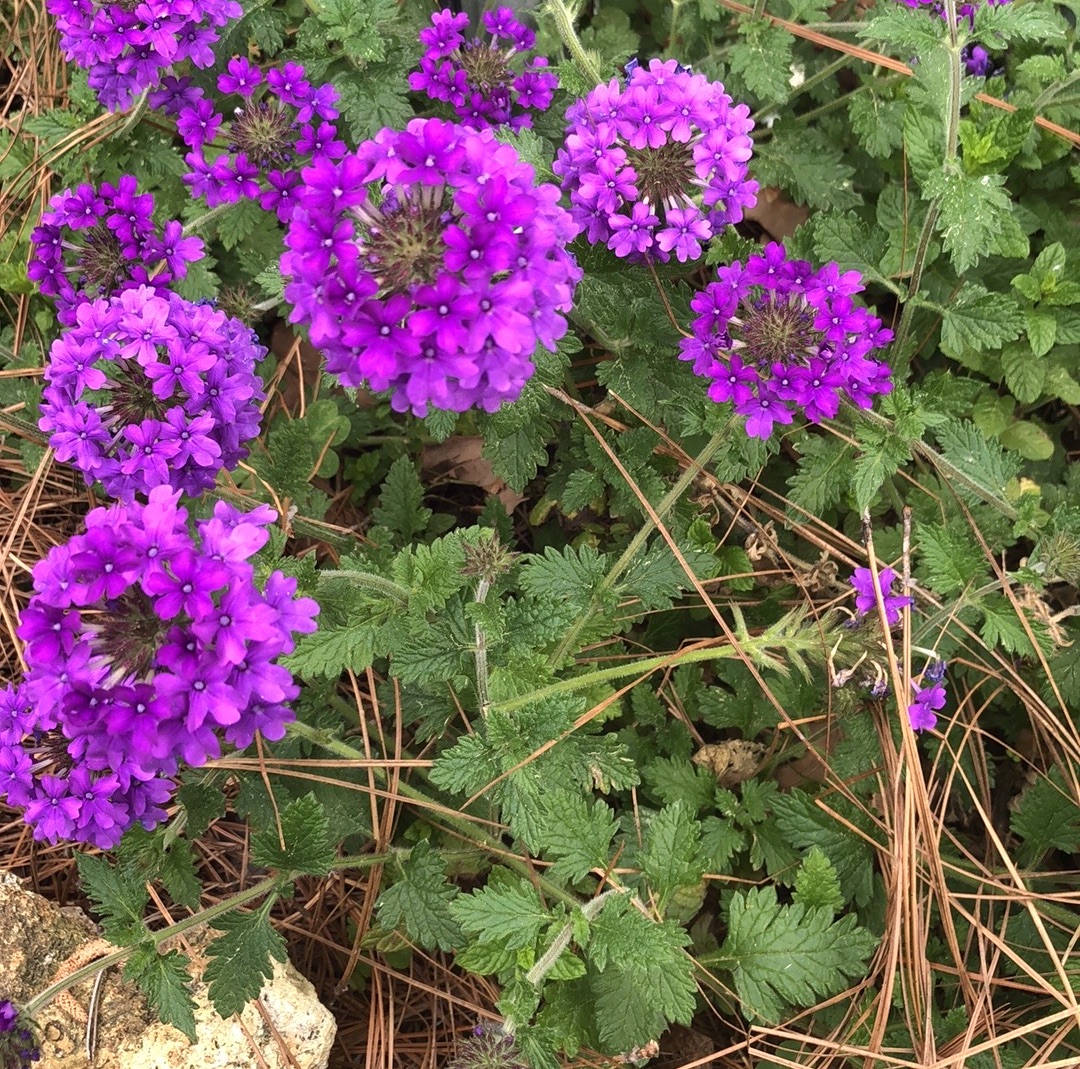
Rose Mock Vervain or Rose Verbena

Behind the House - Fields Just Being Planted

Traditionally, Friday night ends with an annual fish fry. At the sale site, a large white tent with scalloped edges is erected at the back corner of the house. Nine rows of tables line the tent in two columns, two tables wide.

The tables are covered by red and white gingham print cloths secured with plastic clips. Cups, jars, vases, and pitchers dot the tables, holding succulent plant arrangements. Between the plants are bottles of Bettilu and Charles’ Syrup, cane syrup locally grown by Mr. Charles and his wife and cooked on the premises of their home.

Home Made Cane Syrup


SATURDAY -- BBQ Barn, from North Augusta, South Carolina served a delicious fried fish dinner last night. Today they brought us hamburgers, hot dogs, baked beans, and cole slaw today. At both meals, dessert was banana cream puddin’, cookies and cream puddin’, or both! Please note that there is no g in puddin’.


The Sale Begins

The first Angus heifer under the auctioneer’s gavel sold for $12,000. The second went for $10,000. Most sales lead with the finest sale lots because they will command larger prices and condition buyers to pay more. I told you these people are nice, not naïve.

The sale continued, moving through Angus heifers to Hereford heifers, and finally to the Baldy group.

The sale was successful. It took much work and planning. Participation by phone and Internet played a greater role than in past sales. The most significant element was blessings. Providential timing, at the leading edge of COVID-19 isolation strategies. Beautiful weather, one day ahead of a series of rain storms. Willing participants, including local and more distant buyers from Georgia and out of state who appeared in person, and also more cautious people who used technology to stay involved during the sale.

You get a Baldy by cross-breeding Angus and Hereford cattle. Ideally, a Baldy has the finer qualities of each breed. If you have a cattle operation and want strong maternal instincts, femininity, frame, and vigor but are unconcerned by paperwork attesting that an animal is purely this or that, a Baldy deserves your consideration. And honestly, how many of us are either this or that. I think that, in many ways, we are all a little bit Baldy. And it’s a good thing.

When the last lot sold, the auctioneer and guests tallied the results. The farmhands and family helped the tent company disassemble the tables, fold the chairs, and strike the tents. I overheard that the tent vendor really enjoys helping to put on this annual event because these two families are so helpful with the setup and tear-down.

SUNDAY -- Of people and a view of the enterprise

7:30 a.m. The morning sky is lightening. Sunrise is pinking the clouds at the horizon. Silhouettes are taking on their daytime aspects. Birdsong was just complimented by the long note of a train passing in the distance.

There is sound from the kitchen as our hosts prepare the morning meal. Tom just started the coffee in the dining room. The sounds from the coffee maker are like a workout. Push (almost like a hydraulic grunt). Long sigh of steam. Push. Long sigh. Just like a workout, except for the gurgle. If you are lifting weights, please don't gurgle.

Fine People

It's not surprising. When you align yourself with good people, you're going to meet more good people.

We met people staying at the same B&B as us. She works for the University of Georgia Cooperative Extension office while he operates a feed and fencing business. I watched their kids play with and look out for younger kids at the sale. Their sixteen-year-old son tossed a baseball with a younger developing athlete. Their thirteen-year-old daughter kept up with an extremely energetic young girl. While wearing an orthopedic boot on one foot.

During Sunday breakfast we talked about agricultural education in Georgia, and how Future Farmers of America (FFA) plays the role largely played by 4-H in Indiana with livestock. We talked about technical training and workforce development for youth and how Georgia is making it possible for youth to graduate with college credits, sometimes as much as an Associate's degree.

While similar things are happening in Indiana, Georgia is accomplishing it in a county sparsely populated (the county has one high school). I find this challenging and exciting. Exciting that they are getting this done. Challenging that size is no excuse for us.

I also learned that love of the NCAA Men's Basketball Tournament, including the Final Four, is not universal. I was in a place where the passion was for football and many people could not care less about our fervor for roundball.

Another person I met had driven over from Brunswick, and had recently retired from the beef industry in New York. He happened to grow up in my home town in Indiana. That was a particularly nice surprise.

The local pastor blessed the meal at the fish fry, blessed the lunch on Sale Day, and blessed the opening of the sale. I say local. He commutes ninety minutes to lead the congregation and has done so for several years. He is dedicated. He also is perceptive, kind, bold in the Spirit and shared several interesting stories about hunting, which he is particularly fond of.

Other people were friends, neighbors, and cattle men and women from near and far. Daily interaction with the land, the animals, and one another, made them down-to-earth and a pleasure to meet.

The Good Part

As much as we enjoy the sale and admire all the work that goes into the planning and execution of it, the day most special to us is the day after. Then, the pressure is largely gone and we can visit with our family members.

Part of the post-sale visiting is peeking behind the scenes. CES and Predestined Cattle Company have some excellent cattle coming on.

Hereford and Angus Heifers
Kyle Gillooly's father, Jim, took us into several pastures and lots to look at young stock, recipients of embryo transplants, bulls, and newer calves.

Veteran Cattleman Jim Gillooly Points Out Promising Calves


We traveled by Gator to most of the places we went. It behooves you to call "Shotgun!" at your earliest opportunity. The front seat is vastly more comfortable than the utility bed.

Making the Most of a Big, Green Egg

Sunday evening, we visited with Chris and Lynn Oglesby, Jennifer Gillooly's parents at their home.

I won't go into great detail, but here:

Sunday Supper

Yeah. It was like that.

Everybody was gracious and nice to talk to. After a very pleasant visit, we returned to the B&B for the evening. Thanks to Adam O. for his handling of grilling duties with the  Big Green Egg.  And to Tom O. for taking on the management role.

MONDAY -- We had a final visit for this trip with Jim and Jane, their granddaughter Morgan, and as many of the Gilloolys as could attend. Coffee. And pie, because life is too short to wait all the time.

We left knowing we'd drive through a strong storm in Atlanta, but hoped for the best. Despite losing time because of a couple of accidents, we made it into Tennessee in pretty fair time.

Jim Oliver's Smoke House Restaurant Trading Post

Traveling under overcast skies, we made our way to one planned stop en route. The owner of the vehicle we were driving had purchased some grilling spices here before, and wanted to replenish.

As with most of the trip, there were few vehicles on the road outside heavily populated areas. As we approached Monteagle, Tennessee, we skirted a large hill, slowly winding our way to its shoulder. Runoff from an earlier rain cascaded down cut rock faces, splashing from ledges and spraying into the lefthand ditch. In other spots, water had worked its way into seam and burst from the hillside in a white spray.

Finally, the road crested and we headed toward Exit 134. Jim Oliver's Smoke House advertises itself as "your Tennessee mountain get-a-way." The Smoke House offers vacation cabins, scenic backroads with hiking, waterfalls, and overlooks, a restaurant, an old general store that is equal parts sales floor and museum, packed with old cash registers, distilling equipment, and who knows what else. In better times, they offer live music every Friday and Saturday night. It looked like it would an enjoyable place to be. But we got the items we went in for, seeing three other people inside, and went on our way.

Smoke House Restaurant Trading Post

 We cleared Nashville with only one impromptu detour, looked at the time, and decided to keep on going. By 10 p.m., we were home. It may have been one of the stupidest things we've ever done. I hesitate to offer it champion status. This wasn't my first rodeo. But I was incredibly blessed by the doing of it.

One very meaningful thing to witness was the respect my father and these committed cattlemen have for one another. I have known for years that this is a passion for him. I didn't realize how much that passion is appreciated by others in the industry as well as by family. Very affirming.

I'm as excited to have had the chance to spend time together. I've been told that having Dad there was immensely meaningful to those we visited with. I know for me, the traveling, pointing out things of interest, joking, and experiencing were an honor and something I hope we can do again soon.

Saturday, March 7, 2020

Newbie in Nairobi Turns 20

I am nearing a 20th anniversary.

On August 6, 1999, I boarded an airliner and flew through the night to Paris. Three hours after arriving, I began the next leg of the trip to Nairobi, Kenya.


I was traveling on business for a company that excelled at spending, so the flight was comfortable and the accommodations even more so. We were lodged at the Stanley Hotel, a five-star enterprise at the corner of Kenyatta Avenue and Kimathi Street that began in 1902.

We were in Africa to prepare to launch a satellite radio product that had potential to break demographic barriers, deliver entertainment to people within three vast beam footprints, and provide distance learning to even the most remote areas.

Email home. Tuesday, August 10.

"Andarge, our photographer friend, came in late last night. This morning we went to a Masai market. There were all sorts of handicrafts spread out on blankets on a barren hillside.

As soon as we arrived, they split the four of us and took us to different parts of the bazaar. It was mayhem. People constantly tugged on our sleeves and said, "Me next. Okay? You come with me next."

One person would hand us off to another so that we were constantly moved throughout the marketplace, but rarely crossed one another's path. It was very interesting.


I was able to pick up a couple of things, but I think I paid too much. My dollar-to-shilling conversion sense isn't quite as quick as their sales patter. Anyway, I learned and I had an enjoyable time. We came back to the hotel and planned out our remaining time here.

This afternoon we will drive to different parts of the city meeting printing and production vendors and taking photographs."

Present day memory.
The year of our visit, a drought forced a group of Masai to moved their livestock south sooner than usual. They were set up just outside Nairobi. We arranged a visit. Their homes were made of branches and used manure and mud as wattle to weatherproof them. They built fires in the center of the structures and burned manure as well as any available plants that would burn. A smoke hole at the top of the structure allowed smoke to escape, although there was still a strong smoky smell inside. The smoke was supposed to keep flies and bugs away.
Despite the impression one might get from these photos, the tribal leader had gone to university, then returned to his people to lead them. As with any people, assumptions and underestimating are not advised.
When I was in high school, we built feed troughs for livestock. When we visited the Masai village, I noticed similar troughs for their livestock. A point of commonality. It only takes one to encourage looking for others.


Email home. Saturday, August 14.

"Okay. I've been out of the loop and working hard until today. We originally thought today would be a play day. It worked so well, however, that I'm certain we'll be using many of the photos Andarge took for corporate materials to give that genuine African flavor (that's flavour in Kenya, thank you very much).

We left midmorning and drove (flew) over roads that make Washington, DC look like a freshly paved parking lot. Of course, we're in Kenya, so we drive on the left unless another whim strikes.

Our driver was George. He was a great guide. Really. But he was also our driver. George is evidently a man of strong faith who would like nothing better than to meet his Maker. Soon. I suppose he expects brownie points for carpooling to the Pearly Gates.

Okay. Here are the rules:

1) a. Drive on the left. If the road surface there is too broken down, then drive on what's left, which generally is the right. b. Bear in mind that this lane may be occupied. If so, blink your headlights. Somebody will give way.

2) Passing is an art. It can only be developed with continuous practice. There's no better time than the present.

3) You've obviously mastered passing in an open lane. Don't be a shrinking violet. Try it on a hill. Remember, all the gusto is found by passing on a hill into a blind curve. See 1b. The meek shall inherit the earth. It's Heaven we're after. Remember?

4) Yield to major road obstructions (police checkpoints, debris, etc.). Pedestrians move under their own power and are not part of this category.

5) The world is full of options. If both lanes are full, the shoulders are on of those options.

6) Music soothes the savage beast. Honk.

7) Emission controls probably impede your progress. Can't we do without them?

8) Right-of-way means just what it says. Your rights. Your way. Go for it.

That's pretty much Kenyan driving-for-hire in a nutshell. There's not much to it. Like they say in Swahili, Hakuna matata (no problems). I'm sure you'll do fine.

We went to a national wildlife park in Nakuru. Mike, Andarge, and I piled into the rental van--innocents abroad, as it were--and settled int for some fitful rest. In no time at all, it became blind terror, but that ended in exhausted slumber broken only by a bouncing descent onto the dusty shoulder. We fell out of the van and walked out onto a deck built into the hillside.

Having seen local construction practices (if you studied lashing in Boy Scouts, you know EXACTLY what I'm talking about. Scaffolding--even six stories high--is poles that have been lashed together) I went out with some trepidation. But it was worth it.

I had awakened to be shown a view of Kenya's Great Rift Valley. Even in the muted mistiness of a Kenyan morning, it was stunning. We looked down onto a patchwork of small farm plots and tiny clusters of houses that seemed to extend forever. In the distance were three mountains. In the foreground, a railroad track crossed at the very foot of the mountain we were on. The air was cool and moist. Fog hung in the branches of nearby trees.

9) Oh, yes. Rule 9. It's your business and only your business where you're going and even where you are at the moment. If it's foggy or daylight is waning and you turn your headlights on, you'll only be telling everybody your business. We don't want that now, do we?

Magically, a smiling man appeared at my elbow. "Jambo. Come here. Come here. Come with me. I show you some carvings. Is beautiful, no? You my first customer today. I make you special deal. Okay? Okay."

"Oh, boy," I thought. "Here we go again." I learned, though, that being cranky can save you money. I got all scriptural and let my no be no. Then I scurried back into the van and shut the door. It almost made getting back onto the road again bearable."

Eventually, which I suppose means without any events worth mentioning, we arrived in Nakuru. There, we stopped at Midland Hotel for lunch. We were going to simply get coffee, but they served hot water and Nescafe in packets, so we sent it back and ordered Cokes.

Be aware that there is still a place in the world where Coke is served in the bottle, as God intended it. That place is Kenya.

There is also a place where domestic fowl are cooked on a spit, also as God intended it. That place is not Boston Market, Kenny Roger's Roasters, or any other yuppie feeding trough. It's the Midland Hotel, built in 1977 and serving fine chicken, freshly fried potatoes (which may well have been brought into town in a very large bag tied to the back of somebody's bicycle), and a lousy cup of Nescafe powder. But we share a half of a chicken and two plates of fries, sent merrily to their appropriate resting place on a tide of carbonated water and caramel coloring pouring so very properly from a thick glass bottle. And we did it for less than four dollars. While this ain't exactly loaves and fishes material, we're heading in the right direction.

After our meal, we put the top up on the van. Most of the roof of the van is a fiberglass panel that pops up. Should one happen across the King of Beasts, this marvelous feature allows one to see the King's dinner rather than be the King's dinner. I rather liked that thoughtful touch.

When we arrived at the park, we stopped just inside the gate and looked at a group of delightful little monkeys with black faces. Mike and I both posed with them while Andarge took our photos. Then Mike and Andarge walked off. I decided to stay with the van. I closed the sliding door and sat down. From that vantage point I could look just past the driver's headrest into the bright eyes of one monkey who realized that the open window was an invitation for him to sit on the driver's door. He soon scampered onto the windshield and I stood up in case he was headed into the van through the open roof. He was. He barked at me. Poor thing. He was probably frightened. I know I was. So I quickly sat down. After all, I only outweighed him by 215 pounds and it wouldn't have been nice to have pressed my advantage. Fortunately, he left, my companions came back, and we headed into the park.


We saw warthogs, antelope, gazelles, a white rhino and her calf, giraffes, water buffalo, flamingo, guinea hens, monkeys, baboons, dear, and tourists. We tried to go up one road, but the van got hung up on a rock. We were en route to Lion Hill at the time, so it was with even greater trepidation than earlier in the day that I got out to push. No lions. And no memento vendors. So, all in all, that was a fairly decent stop.

We spent about three wonderful, restful, thoroughly enjoyable hours in the park. Andarge go some pictures that we are so excited about. We can hardly wait to get to Johannesburg so we can get the film developed. After the park, we spent two harrowing hours reviewing the Kenyan rules for driving. George was incredibly gracious. Earlier, Mike had earnestly asked to drive more slowly and refrain from passing. I don't know if it was the quaver in Mike's voice or my wide-eyed, unblinking stare, but he did settle down some on the return trip. Not enough, mind you, but some.


So we returned to the hotel, had a splendid hot shower--in our respective rooms--and met for dinner. After dinner, I came into the office to prepare for a little work in the morning and to record the day's adventures. So, there it is. Hakuna matata. God bless."

I did a little bit of growing on this trip. Certainly, my world view expanded. I noticed differences, but seeing them in context I'd like to think I became less judgmental. More understanding. More appreciative. I still have room for growth. I'd go in a minute if somebody offered me the chance to do this again.

Sunday, March 1, 2020

New Word: Because of This, That

I learned a new word today. Etiology. Do you know it?


Etiology is the investigation or attribution of the cause or reason for something, often expressed in terms of historical or mythical explanation. In this case, the something is consequence.

Where did I learn this word? My dad. He's a bountiful source of arcane knowledge and well-grounded wisdom. He has taught Sunday School for quite a few years. He teaches the elder set. By that, I mean that I am easily the youngest in the class and I turn 60 this year.

Dad is curious by nature, so when he teaches, his preparation goes beyond the Leader's Guide. He compares passages from various commentaries, looks at different translations of the scripture verses that the lesson refers to, and also looks at historical sources so he can provide context for what's being presented. Sometimes, he comes across interesting words.

So, etiology.

It came from study for Genesis 3. The New International Version of the the Bible gives this passage a heading, The Fall. If you click on the link, you'll see that the serpent planted doubt in Eve, one of two humans living in a perfect place, Paradise or Eden. The serpent didn't directly confront or refute. Instead it posed the question, "Did God really say, ...?" and let Eve mull it over. Eve replied with an assured response, but the serpent poked at the doubt. "You will not certainly die ..."

Eve is human. Eve is us.

She rationalized why taking the proscribed fruit and eating it was a good thing. It was good for food and pleasing to the eye, and also desirable for gaining wisdom. Lots of pluses. So she did it. That seemed good, so she shared it with her husband, too.

Shortly after that, God asked them what they'd done (vv. 8-13). Adam, the other human in Eden, blamed Eve for giving him the fruit. Eve admitted she'd been deceived, but blamed the serpent. Curiously, the serpent didn't blame anybody. Maybe its work was done.

Like a good parent, God begins dispensing etiology. "Because you've done this, here's what will happen." Cause and consequence.

To the serpent: “Cursed are you above all livestock and all wild animals! You will crawl on your belly and you will eat dust all the days of your life. And I will put enmity between you and the woman, and between your offspring and hers; he will crush your head, and you will strike his heel.”

Cursed above all livestock. Did that mean no nobler purpose? The serpent would not be a source of meat, nourishing bones, wool or hides.

Crawl on your belly. Maybe the serpent had limbs or wings before. Who knows? But to this day, serpents crawl on the ground.

Enmity. Almost all discussion of snakes I've read on social media includes zealots offering no quarter to snakes. And a great deal of fear.

To Eve: "I will make your pains in childbearing very severe; with painful labor you will give birth to children. Your desire will be for your husband, and he will rule over you."

In the moment, consequences can seem like curses.

You will experience severe pain. You will desire your husband, which will lead to more severe pain. Your husband will rule over you.

So two of those three have come to pass. The husband ruling over the wife part needs to be considered case by case.

To Adam: "Cursed is the ground because of you; through painful toil you will eat food from it all the days of your life. It will produce thorns and thistles for you, and you will eat the plants of the field. By the sweat of your brow you will eat your food until you return to the ground, since from it you were taken; for dust you are and to dust you will return."

Here was a significant change. Mankind's new existence was not to walk through a shady garden and pluck food from a tree (think oranges, apples, lemons, limes, grapefruits, peaches, mulberries, persimmons, dates, figs, and also the varieties of nut trees). Instead, we would work bent over to dig into and turn the soil, plant seeds, wait for rain and sunshine while they germinated, separate the crop from the weeds, cut the plants at harvest, dry and thresh, and store against the needs of the winter and the requirement for seed to plant the next year. And then we'd die.


We'd made a horrible mistake.

I say we advisedly. What Eve did in that moment, you and I do every day. We make choices, rationalize our supporting reasons, and sometimes drive a wedge more and more deeply between us and our Creator. At the same time, if we feel we are getting caught out, our response to etiology is to blame. Nearly anyone will do.

With no judgment, abject humility, and deep caring, I suggest we own our actions. Let responsibility rest where it belongs. And accept that, just as separation was a result of our choices, reparation can be too.

Prodigally yours, Dave

Friday, February 28, 2020

What Makes a Houseful? Can You Help Us Itemize?

Imagine, God forbid, there was a fire in your home and you lost everything. The shock of the event is bad enough, but you must itemize your household contents for insurance purposes.

What is gone? Certainly clothing, furniture, appliances, and dishes. But what about the smaller items? Your grandmother's wedding gown. Picture of beloved family members. Personal belongings handed down over several generations. The irreplaceable things.


It's a good exercise. How long would it take you to do this? Try it. Think about what you have, then take a moment and walk from room to room. What items do you see that you'd forgotten?

We did a similar exercise today with our county.


The Cultural Diversity team of Develop Daviess met to discuss next steps toward including every voice in our county. We spent several minutes brainstorming. We filled a large presentation pad of note paper, but we know we have not captured them all.

The list is more varied than you might expect. It also includes groups that are too easily overlooked.

In no particular order, our "house" includes: Amish, English (an Amish term for 'not Amish'), Haitians, Hispanics (representing Puerto Rico, Mexico, Guatemala, El Salvador, and other Latin American countries), people across the economic spectrum from poverty to exceedingly comfortable, a variety of faith groups, people across the political spectrum, people in the LGBTQ community, people recovering from addiction, and others.

So, please help. Who are the others? We're rebuilding our house and we want to make sure this time there clearly is a place for everybody.

Thursday, February 27, 2020

Ash Wednesday and Recognizing Community

I had a question this morning about Ash Wednesday.

What’s Ash Wednesday?

If you are not familiar with Ash Wednesday, it is a holiday in the original sense of the word. It is a holy day at the beginning of the Christian season of Lent, the forty days preceding Easter. A day of prayer and fasting.

Lent doesn’t appear in the Bible, but it is a solemn season of reflection and preparation for the celebration of Easter. During Lent, many Christians symbolically replicate Jesus’ sacrifice and withdrawal into the desert for forty days. They often deny themselves something, reflecting the scarcity of comforts in the desert.

The Mark

Image result for ash wednesday Ash Wednesday marks the first day Lent. And a cross made of ashes marks many people who observe this holy day. The cross symbol is placed on their forehead and they wear it the remainder of the day.

It’s made of ashes and oil or water. It’s a mark of penitence. Contrition. It’s also a very effective way, for at least a day, to identify one’s community.

More than a Feeling

Before we say more about that, I was curious about what wearing ashes feels like. So I asked a friend and learned that, once they are on your forehead, you really don’t feel them. It’s very easy to go about your day and forget that you look different. It’s only when you reach up to rub your forehead and your hand comes away smudged, or you pass a mirror and you are surprised by your reflection. Or, possibly more meaningfully, when you see somebody else who bears the same mark and you recognize them as somebody who shares your faith. And probably your outlook. So at some level, you have found a kindred spirit.

Manageable chunks

Image result for free image shape toy Sometimes our world is too much. We have difficulty making sense of it all. So, we begin sorting. We define shapes or boxes, then and try to get everything to fit accordingly. We look at an item, then try to determine if it is a This or a That.

We consider an idea, and then decide whether we agree with it. Are we Pro, Con, or ambivalent?

With simple things, this is a useful approach. We can sort quickly and decide which things we care about. Which things deserve our concern.

With complex things, our handy system of organizing our world breaks down. The more deeply we dive into a subject, our blanket statements about what to think or how to respond begin to unravel.

Keeping Safe

Part of our penchant for sorting is survival instinct. Every activity has inherent risks. Most of us don’t have to worry about wolves, bears, or invading conquerors today, but we still spend our days making snap judgments about risks.

Is that person good? What do they want? Can I get from my parking spot into the store without being accosted? Is this road slippery? What will happen if my car breaks down. Is my phone charged?

Data Reliability

If we are going to worry anyway, here’s a new concern. Snap judgments are based on our interpretation of available data.

How good are our sources? What if the person who shared information with us is not truthful? What if we are swayed by and acting on fake news?

How good are we? What if we are just lousy interpreters?

Shapes and Boxes

Let’s spend more time with ultra-complex subjects. People. You and me.

How do we find the right boxes? Here are just a few of the shapes and boxes we use. For each, let’s think of descriptive words. Do different words come to mind for you?

Size

Tall. Short. Fit. Fat. Skinny. Morbidly obese. Average. Thick. Muscled. Flabby.

Appearance


Face: Ugly. Handsome. Beautiful. Plain. Unremarkable.

Hair: Shiny. Wavy. Straight. Lank. Limp. Oily. Greasy. Curly. Kinky. Short. Long. Balding. Bald. Shaved. Messy. Skinned.

Age: Infant. Toddler. Child. Youngster. Pre-teen. Adolescent. Young Adult. Adult. Middle-Aged. Mature. Old.

That’s just a sampling. With each label come inferences and suppositions. They may be correct. Let’s remember they also may be far from the mark. There are also the standard sorting methodologies many of us resort to. Does this person:

  • Look like me?
  • Act like me?
  • Talk like me?
  • Dress like me?
  • Live where I live?
  • Drive what I drive?
  • Have a job like mine?

The advantage, and the problem, with these criteria is that they are safe. Like a fence.

Frieze (1905-1915)
Cooper Hewitt Collection


A fence is a sharply defined boundary. Inside that boundary, we have room to move comfortably.

As a boundary, a fence is also a divider. Inside the fence are things that belong. Outside the fence are things that do not belong. They surround us in our safe, fenced area.

As suggested earlier, one simple point of connection can widen the doorway to community. Two crossing swathes of ash right after Mardi Gras allow two people to identify with and accept one another. What else is there? What marks you as somebody another person can relate to? You may not realize the mark is yours. But it's there. Wear it proudly and be open to the conversation it may prompt.

I challenge each of us to stand at our fencerows and talk with the neighbors. That's step one. Step two is to install a gate. It would be pretty radical to take the entire fence down. In fact, it probably wouldn't be a good idea. There are things in my defined space that make me uniquely me. And I'm curious about yours. So, for now, let's just create an entrance in our boundaries and use it for frequent visits.

Welcome in.

Monday, February 24, 2020

15 Dry Phrase Followup


On January 30, I asked my Facebook friends for phrases that need a little help. Here is my request:

This may sound odd, but I'm collecting dry phrases. Strings of words that need life injected into them.

Background: I was talking with a friend recently about coffee--something we both enjoy. Rather than saying, "Hold a cup of coffee" we described it as "wrapping our hands around a hot vessel we hold closely". They are the same thing, but isn't the latter a nicer way to start the day?

So there it is. My goal is to collect 15 dry phrases in the next 15 hours. Please share something you hear or use often that deserves improvement. This will be a fun exercise for me. I'll post all 15 when we're done.


Once again, I find need for greater clarity in my writing. I lost people at "..something you hear or use often that deserves improvement."

I'd hoped to be able to improve marketing for people who need taglines and content to create word pictures or spur emotions. Instead, I’ve assembled a group of very short phrases or even single words that cause people to be peevish. Oh, and I am one of those people.

On the plus side, I received at least 25 word/phrase suggestions, exceeding expectations. This exercise/assignment has rested for nearly a month, so let's see it through, shall we?

Here are our suggested phrases.


Fixing supper.

I'll lead with this one from a writer friend. Connie not only suggested it, she delivered it complete with an alternative. “I am preparing an evening culinary experience.” Why mess with success?


Cool.


This was proposed by my friend Aaiza as a response to "everything someone is saying to you at work when they are just being annoying and you want them to go away."

I do not have an improvement. But be advised. If your conversation with somebody goes:

YOU: Blah, blah, blah.

THEM: Cool.

YOU: Blah blah.

THEM: Cool.

YOU: Blah blah blahbity blah. Right?

THEM: Cool.

There is a very real chance it's not cool. You're probably not cool. And we can confidently doubt you're helping them cross items off their to-do list.

In this scenario, "Cool" means, "I hear you. I'm not wasting brain cells on formulating a considered response to your inane banter. In fact, I'm continuing to solve my own problems, futilely attempting multitasking while you stand in or near my personal space and keep me from my appointed duties. Please leave. My eyes are glazing. Please leave now. Cool?"


Getting gas.


Karen, this could mean fueling, refueling, or temporarily containing organic, semi-toxic emissions. It wasn't clear.

It might be clear soon. But will it be silent? Will it be deadly?


Get dressed. Go to work. Make dinner.


Three mundane activities nearly all of us do or assist with. We:
  • Clothe ourselves, reinforcing our workplace personas.
  • Cross our thresholds and travel, mentally preparing ourselves to achieve and overcome, as required.
  • Return to our homes and create nourishing meals to carry us through all our activities. Or we order pizza. And maybe a 2-liter bottle of a carbonated beverage, artificially colored and brimming with high fructose corn syrup. We have options.


Go brush your teeth!


This is convenient oral shorthand. When we hear it, we know what we're being instructed to do.

It's just much faster than saying, "Go apply flavored dentrifice to a long-handled stubby brush and scrub your pearly implements of mastication until they gleam. At least two minutes. And don't swallow!"


Go figure.


It’s difficult to read this one without hearing the sarcasm oozing from each word and puddling on the floor.

"Go figure" acknowledges an unsurprising outcome. It implies, "What did you think would happen?" and may include terms of endearment like "moron," "idiot," or "you goof."


Hang up your coat/clothes.


I wondered why anyone would have to say such a thing. Then, from my comfy recliner, I noticed one jacket hanging from a door knob, and two sweaters doing dual service as throw rugs beside the chair. I remembered other items of clothing draped over or stacked on chairs in our bedroom.

We are very neat here. But only in our dreams.

So, clear the room. Suspend your clothing.


Hold your horses.


Try "Let's pause" instead. It implies at least a pair of people working together.

It doesn't say, "Stop!" That's the last thing most people who have gathered momentum want to hear.

But, for a moment "let's pause" and consider where we are going, where we want to go, and the best way to get there. Then we can snap the reins and get this wagon moving again.


How are you?/How was work?/Fine


This is less a phrase than a polite question. Either one is often used as a conversation starter.

Unfortunately, neither should be construed to be an authentic invitation to further conversation unless there is continual eye contact. "How are you?" has become a vocal nod. It's done like this: Vocally nod. Break eye contact. Keep moving.

We say it, but we don't mean it. For many years I have wanted to write a song and call it The Hi, How'ya Doin', Walk On By Blues.

Either question can be inauthentic, but so is our standard response. "I'm fine" or "It was fine". Indeed? Or are we assuming it's a pro forma question and the asker doesn't really care?

The person who proposed "Fine" or "I'm fine" as a phrase worthy of reconstruction offers what has become his patent response to "How are you?" Eric says, "If I were any better, I'd be twins." If you know you're not destined for a conversation, at least you can leave the asker with something more than they expect.

If you want to know--really want to know--maintain eye contact and be ready to hear. Stop a minute. Listen. At least one of you will benefit from the contact. It may be you.

If you don't really want to know how somebody is, try "Good morning" or "Good afternoon" instead. If a conversation begins, for goodness' sake, don't respond with, "Cool."


I have to grade papers.


Diane, I'd go with "Not now. I'm dispensing academic judgment. Let the wailing begin."


It is what it is.


This is either abject fatalism or Zen-like acceptance. It may also mean, "I prefer to focus on things within my control."

Many people dislike this saying. I disagree. To me it says, "I accept this as a given, but I refuse to give it more consideration than it deserves. It is. It's fact. But it's nothing more than it is, so let's deal with it or work around it and get on with other things."


It’s all good.


We can work with this.

I have a friend who used this as his personal catch phrase. He took a lot of things in stride and, for him, this phrase meant either, "I can work with this," or "I forgive you," or "I'm already working on a different solution." Usually, the feeling I got was something along the lines of "God uses all things for good." Even the ones we haven't planned.

I have another friend who really dislikes this phrase. She is a beautiful, gifted person with a fantastic sense of humor who has endured enough crappy life experiences to believe that, no, it's not all good. Maybe it can be turned to good, but some of "it" is ugly, demeaning, precarious, uncomfortable, and takes its mental, emotional, and physical toll. Some of "it" feels like an endless slide downhill with no solid handholds.

I love both of them. Mr. Catch Phrase has already been called up to the major leagues, but his optimistic, can-do legacy continues in his family who are still here. Ms. Beautiful Gifted is still slugging it out with life. Meanwhile, she continues to feed into other people through the arts, through counseling, and through humor.

Perhaps not all of it is good, but in some measure I've learned through both people that some of it is life-affirming and excellent.


Let the dog out. Let the dog in. Pet the dog. Good girl.


These canine-centric phrases come from Rosie, who may be Man's Best Friend's best friend. These work. Why change them?

Upon reading the first two, I'd give serious consideration to installing a doggie door. Really. Who's getting trained here?

Pet the dog really makes us feel as good as the dog, so don't think that the object of petting gets all the benefit.


Let’s dip up (food).


I have absolutely no idea. Pam, this is my first exposure to this colloquialism.

The Urban Dictionary has "let's dip" as an alternate phrasing for "Let's go" or "Let's leave," but not in reference to food. Conceivably, at Taco Bell you could say, "Let's dip up, then let's dip." If I'm with you, I'll be lost. Twice.


Let's go. Turn left. Wash the dishes. Gas the car. Go out and play. Paint the house. Knit a sweater. Mow the yard.


A package deal. Wow.

This is a group of phrases that is appropriately succinct. The meaning is clear.

Making the phrase more descriptive could provide useful information. Let's go to the park. Turn left at the second traffic signal. Wash the good china dishes by hand. Take the Buick sedan and fill the gas tank. Play in the back yard. Paint the house light blue. Knit a cable stitch sweater. Mow the yard with the riding mower and trim around the planting beds, patio, and sidewalk.


No problem.


This phrase is entrenched. Toni helpfully raised it and I am particularly annoyed by it. Let’s see if I can rant succinctly.

If you’re in a service position and I say thank you, “no problem” to me is an inappropriate response. You are paid to provide the service. You are correct that it is “no problem.” It is your role. It is your responsibility. It is probably a condition of your continued employment. I rarely imply that it is a problem. Instead, I state my gratitude for your performing with thoughtfulness,  excellence, or both. Somehow, one-third of the Holy Trinity of politeness has broken down. Let’s reinstate Please, Thank You, and You’re Welcome. That should be no problem.


No worries.


If No Problem has a sibling or close cousin, this is probably it. It's a shame, too. I use this phrase. My brother-in-law is Australian and I enjoy hearing him use it, so I've borrowed it and put it into greater circulation. I realize I should have more forbearance. Instead, I hereby promise to not call you "Mate" when I use it.

I think "No worries" has a greater sense of "I'm not troubled by this; you shouldn't be either." It's sometimes used when a person has done a favor for somebody and that beneficiary feels they must repay the favor.


Pretty sunset.


My friend Polly made this suggestion. If you want to see sunshine, get her to smile for you.

"Pretty sunset" is perfectly adequate when you're with somebody and you want them to notice a sunset you find particularly attractive. Imagine you're talking with someone who is not with you. Let's say they are in a different time zone or they are in a building with no windows. Now it's time to be more descriptive.

What is it that makes the sunset pretty to you?
  • Is it the intensity of the light as that brilliant orb slowly slides behind the horizon?
  • Is it the nearly indescribable palette of colors presented? Washes of pink, orange, and indigo--combinations you'd never consider if you were the painter, but now that you see how incredibly beautiful they are together, you're tempted to try.
  • Is it the way trees and buildings become silhouettes, shadows cast by that marvelous light?

When you want to bring somebody into your moment of awe, you'll need to use your best descriptive language.


Shut the door.


This could mean, "You had to open it to walk through it, now put the door back the way you found it."

More likely, this is a case of word substitution. Often seen as "Shut the front door," a polite reframing of "Shut the f__k up". It's a nice trick if you can get away with it. As long as your audience knows the translation, shut the front door can have the same gut-punch effect of its salty alter ego.

As for meaning, it might mean stop talking. More often, it means No way! or You can't be serious!


Six one way, half a dozen the other.


A phrase of equivalence. Toe-may'-toe/Toe-mah'-toe. When faced with a choice that, all things considered, has similar or equivalent pros and cons, you might say, "It's a wash," "The differences don't matter," or "Heads or Tails?"


Sounds good.


Despite sounding affirming, this phrase found its way onto Shamaa's peeve list.

Knowing Shamaa, she either truly wants an alternative or somebody in her sphere of influence says this and she's insightfully interpreting it as "Right. What you said. I'm not going to apply myself fully to this situation." If that's the case, "I'll take time to give this the consideration it warrants" would be a much better rephrasing. And also a much better approach.


Sure.


Alison, hopefully you can infer this to mean, "You can be certain of it." I'll not be surprised if it is a monosyllabic, slightly confusing replacement for "You're welcome." If so, it carries even less meaning than "Not a problem."


Time for dinner.


Ms. Sabadash, you had me at "dinner." Yum. To rephrase, "We're doing a disappearing act with food. I'll need your assistance." Leave out the part about Brussels Sprouts unless your crew likes 'em.


WTF


Sue says, "WTF has an immediate answer that comes to mind. But what else could those three letters mean? Whiskey Tango Foxtrot is one. Others?"

Whiskey Tango Foxtrot is the phoneticized version of the acronym WTF rather than an alternate meaning. As for other expansions of WTF, certainly there is the tamed version, "What the Frick?" Wiktionary also offers us World Taekwondo Federation. Wu Tang Fan would be another logical expansion, but I just made it up. Let's explore the F of WTF further.


How to Give a F


Speaking of "frick", the f in the F word is a fricative, a sound produced by high pressure air flow between a narrow space in the mouth. In this case, it's between the lower teeth and the upper lip. The vocal cords are not involved.

Short-u is pronounced in the center (not front, not back) middle (not high, not low) part of the mouth, and the tongue needs to be relaxed. Phonetics instructors describe the short-u sound as one of the most relaxed sounds we make in the English language.

To make the k sound, we lift the back of the tongue, then cut the air flow. Again, as with the fricative, our vocal cords are not involved.

The F word is special to me.

As we've learned, the F word is economical. Only the short-u sound involves the vocal cords. The fricative at the front of the word feels good, like the release of air from a balloon. We can make the short-u sound brief or long without significantly distorting the word. And the k sound at the end brings the whole experience to a crisp, defined closure. Shut the door!

The F word works well with dynamics.

  • Whisper it to yourself. Go ahead. Just like you want to when your computer fouls up. It's almost an invocation. A cry for justice. Why aren't things working?
  • Say it. Make it short or draw it out. It's all good. Six of one, half dozen of the other. It's a built-in tension release you can always have nearby.
Do this next step only if you're in a safe, private place.
  • Shout it! Release that air and clamp the whole thing down with a hard k sound. Feel better? Go figure. Excellent.

Using this simple tool, you've just expressed a range of emotions. It's less expensive than a spa visit. It wards off strangers. It even puts co-workers on notice. Invaluable. Don't thank me. It's no problem.