Imagine, God forbid, there was a fire in your home and you lost everything. The shock of the event is bad enough, but you must itemize your household contents for insurance purposes.
What is gone? Certainly clothing, furniture, appliances, and dishes. But what about the smaller items? Your grandmother's wedding gown. Picture of beloved family members. Personal belongings handed down over several generations. The irreplaceable things.
It's a good exercise. How long would it take you to do this? Try it. Think about what you have, then take a moment and walk from room to room. What items do you see that you'd forgotten?
We did a similar exercise today with our county.
The Cultural Diversity team of Develop Daviess met to discuss next steps toward including every voice in our county. We spent several minutes brainstorming. We filled a large presentation pad of note paper, but we know we have not captured them all.
The list is more varied than you might expect. It also includes groups that are too easily overlooked.
In no particular order, our "house" includes:
Amish, English (an Amish term for 'not Amish'), Haitians, Hispanics (representing Puerto Rico, Mexico, Guatemala, El Salvador, and other Latin American countries), people across the economic spectrum from poverty to exceedingly comfortable, a variety of faith groups, people across the political spectrum, people in the LGBTQ community, people recovering from addiction, and others.
So, please help. Who are the others?
We're rebuilding our house and we want to make sure this time there clearly is a place for everybody.
Friday, February 28, 2020
Thursday, February 27, 2020
Ash Wednesday and Recognizing Community
I had a question this morning about Ash Wednesday.
Lent doesn’t appear in the Bible, but it is a solemn season of reflection and preparation for the celebration of Easter. During Lent, many Christians symbolically replicate Jesus’ sacrifice and withdrawal into the desert for forty days. They often deny themselves something, reflecting the scarcity of comforts in the desert.
Ash Wednesday marks the first day Lent. And a cross made of ashes marks many people who observe this holy day. The cross symbol is placed on their forehead and they wear it the remainder of the day.
It’s made of ashes and oil or water. It’s a mark of penitence. Contrition. It’s also a very effective way, for at least a day, to identify one’s community.
Sometimes our world is too much. We have difficulty making sense of it all. So, we begin sorting. We define shapes or boxes, then and try to get everything to fit accordingly.
We look at an item, then try to determine if it is a This or a That.
We consider an idea, and then decide whether we agree with it. Are we Pro, Con, or ambivalent?
With simple things, this is a useful approach. We can sort quickly and decide which things we care about. Which things deserve our concern.
With complex things, our handy system of organizing our world breaks down. The more deeply we dive into a subject, our blanket statements about what to think or how to respond begin to unravel.
Is that person good? What do they want? Can I get from my parking spot into the store without being accosted? Is this road slippery? What will happen if my car breaks down. Is my phone charged?
How good are our sources? What if the person who shared information with us is not truthful? What if we are swayed by and acting on fake news?
How good are we? What if we are just lousy interpreters?
How do we find the right boxes? Here are just a few of the shapes and boxes we use. For each, let’s think of descriptive words. Do different words come to mind for you?
Face: Ugly. Handsome. Beautiful. Plain. Unremarkable.
Hair: Shiny. Wavy. Straight. Lank. Limp. Oily. Greasy. Curly. Kinky. Short. Long. Balding. Bald. Shaved. Messy. Skinned.
Age: Infant. Toddler. Child. Youngster. Pre-teen. Adolescent. Young Adult. Adult. Middle-Aged. Mature. Old.
That’s just a sampling. With each label come inferences and suppositions. They may be correct. Let’s remember they also may be far from the mark. There are also the standard sorting methodologies many of us resort to. Does this person:
The advantage, and the problem, with these criteria is that they are safe. Like a fence.
A fence is a sharply defined boundary. Inside that boundary, we have room to move comfortably.
As a boundary, a fence is also a divider. Inside the fence are things that belong. Outside the fence are things that do not belong. They surround us in our safe, fenced area.
As suggested earlier, one simple point of connection can widen the doorway to community. Two crossing swathes of ash right after Mardi Gras allow two people to identify with and accept one another. What else is there? What marks you as somebody another person can relate to? You may not realize the mark is yours. But it's there. Wear it proudly and be open to the conversation it may prompt.
I challenge each of us to stand at our fencerows and talk with the neighbors. That's step one. Step two is to install a gate. It would be pretty radical to take the entire fence down. In fact, it probably wouldn't be a good idea. There are things in my defined space that make me uniquely me. And I'm curious about yours. So, for now, let's just create an entrance in our boundaries and use it for frequent visits.
Welcome in.
What’s Ash Wednesday?
If you are not familiar with Ash Wednesday, it is a holiday in the original sense of the word. It is a holy day at the beginning of the Christian season of Lent, the forty days preceding Easter. A day of prayer and fasting.Lent doesn’t appear in the Bible, but it is a solemn season of reflection and preparation for the celebration of Easter. During Lent, many Christians symbolically replicate Jesus’ sacrifice and withdrawal into the desert for forty days. They often deny themselves something, reflecting the scarcity of comforts in the desert.
The Mark
Ash Wednesday marks the first day Lent. And a cross made of ashes marks many people who observe this holy day. The cross symbol is placed on their forehead and they wear it the remainder of the day.
It’s made of ashes and oil or water. It’s a mark of penitence. Contrition. It’s also a very effective way, for at least a day, to identify one’s community.
More than a Feeling
Before we say more about that, I was curious about what wearing ashes feels like. So I asked a friend and learned that, once they are on your forehead, you really don’t feel them. It’s very easy to go about your day and forget that you look different. It’s only when you reach up to rub your forehead and your hand comes away smudged, or you pass a mirror and you are surprised by your reflection. Or, possibly more meaningfully, when you see somebody else who bears the same mark and you recognize them as somebody who shares your faith. And probably your outlook. So at some level, you have found a kindred spirit.Manageable chunks
We consider an idea, and then decide whether we agree with it. Are we Pro, Con, or ambivalent?
With simple things, this is a useful approach. We can sort quickly and decide which things we care about. Which things deserve our concern.
With complex things, our handy system of organizing our world breaks down. The more deeply we dive into a subject, our blanket statements about what to think or how to respond begin to unravel.
Keeping Safe
Part of our penchant for sorting is survival instinct. Every activity has inherent risks. Most of us don’t have to worry about wolves, bears, or invading conquerors today, but we still spend our days making snap judgments about risks.Is that person good? What do they want? Can I get from my parking spot into the store without being accosted? Is this road slippery? What will happen if my car breaks down. Is my phone charged?
Data Reliability
If we are going to worry anyway, here’s a new concern. Snap judgments are based on our interpretation of available data.How good are our sources? What if the person who shared information with us is not truthful? What if we are swayed by and acting on fake news?
How good are we? What if we are just lousy interpreters?
Shapes and Boxes
Let’s spend more time with ultra-complex subjects. People. You and me.How do we find the right boxes? Here are just a few of the shapes and boxes we use. For each, let’s think of descriptive words. Do different words come to mind for you?
Size
Tall. Short. Fit. Fat. Skinny. Morbidly obese. Average. Thick. Muscled. Flabby.Appearance
Face: Ugly. Handsome. Beautiful. Plain. Unremarkable.
Hair: Shiny. Wavy. Straight. Lank. Limp. Oily. Greasy. Curly. Kinky. Short. Long. Balding. Bald. Shaved. Messy. Skinned.
Age: Infant. Toddler. Child. Youngster. Pre-teen. Adolescent. Young Adult. Adult. Middle-Aged. Mature. Old.
That’s just a sampling. With each label come inferences and suppositions. They may be correct. Let’s remember they also may be far from the mark. There are also the standard sorting methodologies many of us resort to. Does this person:
- Look like me?
- Act like me?
- Talk like me?
- Dress like me?
- Live where I live?
- Drive what I drive?
- Have a job like mine?
The advantage, and the problem, with these criteria is that they are safe. Like a fence.
![]() |
| Frieze (1905-1915) Cooper Hewitt Collection |
A fence is a sharply defined boundary. Inside that boundary, we have room to move comfortably.
As a boundary, a fence is also a divider. Inside the fence are things that belong. Outside the fence are things that do not belong. They surround us in our safe, fenced area.
As suggested earlier, one simple point of connection can widen the doorway to community. Two crossing swathes of ash right after Mardi Gras allow two people to identify with and accept one another. What else is there? What marks you as somebody another person can relate to? You may not realize the mark is yours. But it's there. Wear it proudly and be open to the conversation it may prompt.
I challenge each of us to stand at our fencerows and talk with the neighbors. That's step one. Step two is to install a gate. It would be pretty radical to take the entire fence down. In fact, it probably wouldn't be a good idea. There are things in my defined space that make me uniquely me. And I'm curious about yours. So, for now, let's just create an entrance in our boundaries and use it for frequent visits.
Welcome in.
Monday, February 24, 2020
15 Dry Phrase Followup
On January 30, I asked my Facebook friends for phrases that need a little help. Here is my request:
This may sound odd, but I'm collecting dry phrases. Strings of words that need life injected into them.
Background: I was talking with a friend recently about coffee--something we both enjoy. Rather than saying, "Hold a cup of coffee" we described it as "wrapping our hands around a hot vessel we hold closely". They are the same thing, but isn't the latter a nicer way to start the day?
So there it is. My goal is to collect 15 dry phrases in the next 15 hours. Please share something you hear or use often that deserves improvement. This will be a fun exercise for me. I'll post all 15 when we're done.
Once again, I find need for greater clarity in my writing. I lost people at "..something you hear or use often that deserves improvement."
I'd hoped to be able to improve marketing for people who need taglines and content to create word pictures or spur emotions. Instead, I’ve assembled a group of very short phrases or even single words that cause people to be peevish. Oh, and I am one of those people.
On the plus side, I received at least 25 word/phrase suggestions, exceeding expectations. This exercise/assignment has rested for nearly a month, so let's see it through, shall we?
Here are our suggested phrases.
Fixing supper.
I'll lead with this one from a writer friend. Connie not only suggested it, she delivered it complete with an alternative. “I am preparing an evening culinary experience.” Why mess with success?Cool.
This was proposed by my friend Aaiza as a response to "everything someone is saying to you at work when they are just being annoying and you want them to go away."
I do not have an improvement. But be advised. If your conversation with somebody goes:
YOU: Blah, blah, blah.
THEM: Cool.
YOU: Blah blah.
THEM: Cool.
YOU: Blah blah blahbity blah. Right?
THEM: Cool.
There is a very real chance it's not cool. You're probably not cool. And we can confidently doubt you're helping them cross items off their to-do list.
In this scenario, "Cool" means, "I hear you. I'm not wasting brain cells on formulating a considered response to your inane banter. In fact, I'm continuing to solve my own problems, futilely attempting multitasking while you stand in or near my personal space and keep me from my appointed duties. Please leave. My eyes are glazing. Please leave now. Cool?"
Getting gas.
Karen, this could mean fueling, refueling, or temporarily containing organic, semi-toxic emissions. It wasn't clear.
It might be clear soon. But will it be silent? Will it be deadly?
Get dressed. Go to work. Make dinner.
Three mundane activities nearly all of us do or assist with. We:
- Clothe ourselves, reinforcing our workplace personas.
- Cross our thresholds and travel, mentally preparing ourselves to achieve and overcome, as required.
- Return to our homes and create nourishing meals to carry us through all our activities. Or we order pizza. And maybe a 2-liter bottle of a carbonated beverage, artificially colored and brimming with high fructose corn syrup. We have options.
Go brush your teeth!
This is convenient oral shorthand. When we hear it, we know what we're being instructed to do.
It's just much faster than saying, "Go apply flavored dentrifice to a long-handled stubby brush and scrub your pearly implements of mastication until they gleam. At least two minutes. And don't swallow!"
Go figure.
It’s difficult to read this one without hearing the sarcasm oozing from each word and puddling on the floor.
"Go figure" acknowledges an unsurprising outcome. It implies, "What did you think would happen?" and may include terms of endearment like "moron," "idiot," or "you goof."
Hang up your coat/clothes.
I wondered why anyone would have to say such a thing. Then, from my comfy recliner, I noticed one jacket hanging from a door knob, and two sweaters doing dual service as throw rugs beside the chair. I remembered other items of clothing draped over or stacked on chairs in our bedroom.
We are very neat here. But only in our dreams.
So, clear the room. Suspend your clothing.
Hold your horses.
Try "Let's pause" instead. It implies at least a pair of people working together.
It doesn't say, "Stop!" That's the last thing most people who have gathered momentum want to hear.
But, for a moment "let's pause" and consider where we are going, where we want to go, and the best way to get there. Then we can snap the reins and get this wagon moving again.
How are you?/How was work?/Fine
This is less a phrase than a polite question. Either one is often used as a conversation starter.
Unfortunately, neither should be construed to be an authentic invitation to further conversation unless there is continual eye contact. "How are you?" has become a vocal nod. It's done like this: Vocally nod. Break eye contact. Keep moving.
We say it, but we don't mean it. For many years I have wanted to write a song and call it The Hi, How'ya Doin', Walk On By Blues.
Either question can be inauthentic, but so is our standard response. "I'm fine" or "It was fine". Indeed? Or are we assuming it's a pro forma question and the asker doesn't really care?
The person who proposed "Fine" or "I'm fine" as a phrase worthy of reconstruction offers what has become his patent response to "How are you?" Eric says, "If I were any better, I'd be twins." If you know you're not destined for a conversation, at least you can leave the asker with something more than they expect.
If you want to know--really want to know--maintain eye contact and be ready to hear. Stop a minute. Listen. At least one of you will benefit from the contact. It may be you.
If you don't really want to know how somebody is, try "Good morning" or "Good afternoon" instead. If a conversation begins, for goodness' sake, don't respond with, "Cool."
I have to grade papers.
Diane, I'd go with "Not now. I'm dispensing academic judgment. Let the wailing begin."
It is what it is.
This is either abject fatalism or Zen-like acceptance. It may also mean, "I prefer to focus on things within my control."
Many people dislike this saying. I disagree. To me it says, "I accept this as a given, but I refuse to give it more consideration than it deserves. It is. It's fact. But it's nothing more than it is, so let's deal with it or work around it and get on with other things."
It’s all good.
We can work with this.
I have a friend who used this as his personal catch phrase. He took a lot of things in stride and, for him, this phrase meant either, "I can work with this," or "I forgive you," or "I'm already working on a different solution." Usually, the feeling I got was something along the lines of "God uses all things for good." Even the ones we haven't planned.
I have another friend who really dislikes this phrase. She is a beautiful, gifted person with a fantastic sense of humor who has endured enough crappy life experiences to believe that, no, it's not all good. Maybe it can be turned to good, but some of "it" is ugly, demeaning, precarious, uncomfortable, and takes its mental, emotional, and physical toll. Some of "it" feels like an endless slide downhill with no solid handholds.
I love both of them. Mr. Catch Phrase has already been called up to the major leagues, but his optimistic, can-do legacy continues in his family who are still here. Ms. Beautiful Gifted is still slugging it out with life. Meanwhile, she continues to feed into other people through the arts, through counseling, and through humor.
Perhaps not all of it is good, but in some measure I've learned through both people that some of it is life-affirming and excellent.
Let the dog out. Let the dog in. Pet the dog. Good girl.
These canine-centric phrases come from Rosie, who may be Man's Best Friend's best friend. These work. Why change them?
Upon reading the first two, I'd give serious consideration to installing a doggie door. Really. Who's getting trained here?
Pet the dog really makes us feel as good as the dog, so don't think that the object of petting gets all the benefit.
Let’s dip up (food).
I have absolutely no idea. Pam, this is my first exposure to this colloquialism.
The Urban Dictionary has "let's dip" as an alternate phrasing for "Let's go" or "Let's leave," but not in reference to food. Conceivably, at Taco Bell you could say, "Let's dip up, then let's dip." If I'm with you, I'll be lost. Twice.
Let's go. Turn left. Wash the dishes. Gas the car. Go out and play. Paint the house. Knit a sweater. Mow the yard.
A package deal. Wow.
This is a group of phrases that is appropriately succinct. The meaning is clear.
Making the phrase more descriptive could provide useful information. Let's go to the park. Turn left at the second traffic signal. Wash the good china dishes by hand. Take the Buick sedan and fill the gas tank. Play in the back yard. Paint the house light blue. Knit a cable stitch sweater. Mow the yard with the riding mower and trim around the planting beds, patio, and sidewalk.
No problem.
This phrase is entrenched. Toni helpfully raised it and I am particularly annoyed by it. Let’s see if I can rant succinctly.
If you’re in a service position and I say thank you, “no problem” to me is an inappropriate response. You are paid to provide the service. You are correct that it is “no problem.” It is your role. It is your responsibility. It is probably a condition of your continued employment. I rarely imply that it is a problem. Instead, I state my gratitude for your performing with thoughtfulness, excellence, or both. Somehow, one-third of the Holy Trinity of politeness has broken down. Let’s reinstate Please, Thank You, and You’re Welcome. That should be no problem.
No worries.
If No Problem has a sibling or close cousin, this is probably it. It's a shame, too. I use this phrase. My brother-in-law is Australian and I enjoy hearing him use it, so I've borrowed it and put it into greater circulation. I realize I should have more forbearance. Instead, I hereby promise to not call you "Mate" when I use it.
I think "No worries" has a greater sense of "I'm not troubled by this; you shouldn't be either." It's sometimes used when a person has done a favor for somebody and that beneficiary feels they must repay the favor.
Pretty sunset.
My friend Polly made this suggestion. If you want to see sunshine, get her to smile for you.
"Pretty sunset" is perfectly adequate when you're with somebody and you want them to notice a sunset you find particularly attractive. Imagine you're talking with someone who is not with you. Let's say they are in a different time zone or they are in a building with no windows. Now it's time to be more descriptive.
What is it that makes the sunset pretty to you?
- Is it the intensity of the light as that brilliant orb slowly slides behind the horizon?
- Is it the nearly indescribable palette of colors presented? Washes of pink, orange, and indigo--combinations you'd never consider if you were the painter, but now that you see how incredibly beautiful they are together, you're tempted to try.
- Is it the way trees and buildings become silhouettes, shadows cast by that marvelous light?
When you want to bring somebody into your moment of awe, you'll need to use your best descriptive language.
Shut the door.
This could mean, "You had to open it to walk through it, now put the door back the way you found it."
More likely, this is a case of word substitution. Often seen as "Shut the front door," a polite reframing of "Shut the f__k up". It's a nice trick if you can get away with it. As long as your audience knows the translation, shut the front door can have the same gut-punch effect of its salty alter ego.
As for meaning, it might mean stop talking. More often, it means No way! or You can't be serious!
Six one way, half a dozen the other.
A phrase of equivalence. Toe-may'-toe/Toe-mah'-toe. When faced with a choice that, all things considered, has similar or equivalent pros and cons, you might say, "It's a wash," "The differences don't matter," or "Heads or Tails?"
Sounds good.
Despite sounding affirming, this phrase found its way onto Shamaa's peeve list.
Knowing Shamaa, she either truly wants an alternative or somebody in her sphere of influence says this and she's insightfully interpreting it as "Right. What you said. I'm not going to apply myself fully to this situation." If that's the case, "I'll take time to give this the consideration it warrants" would be a much better rephrasing. And also a much better approach.
Sure.
Alison, hopefully you can infer this to mean, "You can be certain of it." I'll not be surprised if it is a monosyllabic, slightly confusing replacement for "You're welcome." If so, it carries even less meaning than "Not a problem."
Time for dinner.
Ms. Sabadash, you had me at "dinner." Yum. To rephrase, "We're doing a disappearing act with food. I'll need your assistance." Leave out the part about Brussels Sprouts unless your crew likes 'em.
WTF
Sue says, "WTF has an immediate answer that comes to mind. But what else could those three letters mean? Whiskey Tango Foxtrot is one. Others?"
Whiskey Tango Foxtrot is the phoneticized version of the acronym WTF rather than an alternate meaning. As for other expansions of WTF, certainly there is the tamed version, "What the Frick?" Wiktionary also offers us World Taekwondo Federation. Wu Tang Fan would be another logical expansion, but I just made it up. Let's explore the F of WTF further.
How to Give a F
Speaking of "frick", the f in the F word is a fricative, a sound produced by high pressure air flow between a narrow space in the mouth. In this case, it's between the lower teeth and the upper lip. The vocal cords are not involved.
Short-u is pronounced in the center (not front, not back) middle (not high, not low) part of the mouth, and the tongue needs to be relaxed. Phonetics instructors describe the short-u sound as one of the most relaxed sounds we make in the English language.
To make the k sound, we lift the back of the tongue, then cut the air flow. Again, as with the fricative, our vocal cords are not involved.
The F word is special to me.
As we've learned, the F word is economical. Only the short-u sound involves the vocal cords. The fricative at the front of the word feels good, like the release of air from a balloon. We can make the short-u sound brief or long without significantly distorting the word. And the k sound at the end brings the whole experience to a crisp, defined closure. Shut the door!
The F word works well with dynamics.
- Whisper it to yourself. Go ahead. Just like you want to when your computer fouls up. It's almost an invocation. A cry for justice. Why aren't things working?
- Say it. Make it short or draw it out. It's all good. Six of one, half dozen of the other. It's a built-in tension release you can always have nearby.
- Shout it! Release that air and clamp the whole thing down with a hard k sound. Feel better? Go figure. Excellent.
Using this simple tool, you've just expressed a range of emotions. It's less expensive than a spa visit. It wards off strangers. It even puts co-workers on notice. Invaluable. Don't thank me. It's no problem.
Wednesday, February 12, 2020
Cruising Texas Hill Country
This week I have left Indiana to spend some time with a friend in Texas. He wants to revisit some old haunts and that's much better done with company. So I'm seeing parts of Texas through his memories. It's fun.
Thanks to some very attractive fares, we flew into Austin, then made our way into a couple of northwestern suburbs.
I Like My Music Strait
You can be forgiven if you see this sign and think, "Why that must be George."
![]() |
| Strait Music Store |
Right idea, wrong Strait. I thought the same thing, then looked up the history of the store. With more than 50 years of history serving Austin, clearly there are two Strait families with strong ties to music and to Texas.
Our base of operations is Towneplace Suites by Marriott. That puts us within fairly easy reach of friends to visit, old haunts, and Texas Hill Country.
Barbecue
Rudy's Country Store and Bar-B-Q, Austin, TX
My friend is no more a Barbecue Snob than I am a Bourbon Snob. But we both know what we like. He is particularly partial to Rudy's Country Store and Bar-B-Q. Rudy's is a chain that has grown since it opened in 1989 and has now spread well beyond Texas. Austin was my first official visit to this popular restaurant.![]() |
| Rudy's and Its Famous Barb-B-Q Sause |
During our visit, we sampled sausage, moist brisket, dry brisket, and baby back ribs with cole slaw, pickles, onions, white bread, and sweet tea.
The serving staff were very accommodating. No matter what you ordered, they first presented it to you and asked if it looked okay. Then they weighed it and put it into your "basket," a large, deep, plastic tray lined with coated butcher paper. "Plates" were folded pieces of butcher paper added to the tray and each item ordered was served on waxed paper, keeping all the flavors separate.
Seating was at thick tables flanked by benches. Just swing a leg over, hunker down, and get to eatin'.
![]() |
| Baby Back Ribs |
![]() |
| Cole Slaw |
Maybe someone can explain to me this pest deterrent system. Throughout the porch area where we were dining, plastic bags of water are suspended from the rafters. Apparently, flies do not care for bags of water and this proves successful in limiting the number of incursions into patrons' meals.
![]() |
| No-Fly Zone |
Black's Barbecue, San Marcos, TX
Because one meal of brisket is never enough, we also met a friend at Black's Barbecue in San Marcos the next day. This is one of four locations for this outfit.The exterior of the San Marcos location is fairly nondescript. It is on a side street near an industrial pipe supplier and what looked like an old cotton exchange. The intersection of Grove and Hull was flooded from the rains the area has been having. We pulled into the gravel lot, walked past the cornhole boards and beneath the hanging lights, and found the secret to Black's success was on the inside.
![]() |
| Black's Barbecue Outdoor Seating |
Very little can compete with staff who are totally sold on their product. From the time we arrived at Black's, we were treated like family. A lady came up and talked with us. She got us samples of the smoked turkey. I decided that would be my meal. She brought us a sample of the mashed potatoes and showed us that creamed corn as a topping is superior to gravy. I decided that would be one of my sides. As we ordered, we were given sample slices of fatty brisket and pork belly. Each staff member was enthusiastic and truly seemed intent on making certain we fully appreciated their work and enjoyed our visit.
They also had an eye for the competition. My friend was wearing a Salt Lick tee shirt, a competing restaurant. Folks brought him a Black's Barbecue tee shirt and gave it to him. They hoped he'd exchange the Salt Lick shirt, or at least cover it. But they didn't push. Much.
Three very contented men left that restaurant with good memories, an excellent impression of the place, and absolutely no reason to offer anything but praise to family and friends. I would love to return again soon.
Hill Country
When you adopt a place as your own, you want to share it. My friend came to Texas several years ago, met his wife, started a family, and continued to enjoy so much that Texas has to offer. Part of that is food. So we have tried the barbecue here and he continually shows me excellent sources of Latin American food where we live in Indiana.
He also came to love the natural beauty of Texas, so our next destination was not a place, but a region. Texas Hill Country.
br />Like Austin and San Antonio, San Marcos was settled at the base of the Balcones Escarpment and is known as one of the major entry points to the greater Hill Country area. We began from there and soon were climbing into the hills toward Wimberley, Blanco, Johnson City, and Marble Falls, then returning to Austin by way of Lago Vista.
I've read often about this part of the country. Louis L'Amour used it as the setting for several of his books and writes of cowboys brush popping, riding through the all but impenetrable thickets to gather and drive cattle back to the roundup area.
We saw cattle and sheep herds in open areas along the drive and we also saw dense thickets. The thickets looked like they'd be no fun at all to ride a horse through. And even less fun to meet a large, angry animal in and have little room for evasive maneuvers.
![]() |
| The topography changes as we see roadways climb and we peer off into valleys on either side of the highway. |
![]() |
| Live oaks fill the areas beside the highway. Brush is cleared way around some. For others, brush and scrub choke the area, limiting sight lines and passage. |
Many of the roadways were relatively straight lines between towns, but we also encountered curving, twisting roads that seemed tailor-made for sports cars or motorcycles. With temperatures in the high 50s in mid-February, central Texas seemed just the place to be.
Andalusia Whiskey, Blanco, TX
Outside Blanco, we passed a blue building with the name Andalusia Whiskey Co. prominently displayed on the front. It was a distillery. I've never visited a distillery and had hoped to see one during this trip, so we turned around and went inside. Andalusia proudly creates several varieties of Texas whiskey, which notably differs from Midwestern whiskies.
![]() |
| Andalusia Whiskey Flight |
We tried a flight of the Triple Distilled, Revenant Oak, and Stryker.
Each was good in its own way, but the budget was unforgiving. So only the Stryker will be making an appearance at the end of the trip.
Zoom into those labels or look at them on the Andalusia website. The work was done by a good friend of the owner. It's hand-drawn, including the lettering, and is beautiful. It's wonderful to see that level of craftsmanship.
The attention to detail carries through to the tasting room, the lounge at the back of the building, and the whole feel of Andalusia's enterprise. Viewing windows allow visitors to see the distilling process as it's underway. The smoke house is visible from the lounge. An outdoor covered patio area accommodates a number of people, so gather your crowd, visit Blanco, and make an outing of it.
Having sampled the flight and made our purchase, we continued our trip north to Marble Falls. It was mid-afternoon and beyond time for a cup of coffee. Google Maps is a godsend. And it sent us to Numinous.- Triple Distilled is like an Irish whiskey. It is smooth with vanilla notes. Very pleasant.
- Revenant Oak is peaty and more like a single-malt Scotch, but distinctly American, aged in used American bourbon barrels.
- Stryker, as the co-owner pointed out, is unabashedly "smoke-forward" and is smoked with oak, mesquite, and apple woods, then aged in new, charred barrels.
Each was good in its own way, but the budget was unforgiving. So only the Stryker will be making an appearance at the end of the trip.
Zoom into those labels or look at them on the Andalusia website. The work was done by a good friend of the owner. It's hand-drawn, including the lettering, and is beautiful. It's wonderful to see that level of craftsmanship.
The attention to detail carries through to the tasting room, the lounge at the back of the building, and the whole feel of Andalusia's enterprise. Viewing windows allow visitors to see the distilling process as it's underway. The smoke house is visible from the lounge. An outdoor covered patio area accommodates a number of people, so gather your crowd, visit Blanco, and make an outing of it.
Numinous Coffee Roasters, Marble Falls, TX
If, like me, you know you've heard the word numinous but you're not recalling what it means, let's let them explain.
As centerpieces go, this one is impressive:
That's right. Just build the room around it.
Numinous has that special feeling that comes from environment and attitude. The person at the register was kind, welcoming, and helpful. She led me to a gluten-free peanut butter and chocolate chip cookie, which I felt was honoring to my wife's concern for my health. And also to my sweet tooth. My friend was skeptical, but was quickly converted to the marvelous possibilities offered by gluten-free foods.
The interior was inviting, with ample seating for small groups.
![]() |
| Drink fixings area |
![]() |
| Menu and cold drink selections |
![]() |
| Numinous Specials Board |
There was more seating available outside, which was particularly appealing to us on a mild day in the middle of February.
We made short work of our coffees and cookie, then headed east to Austin via Lago Vista.
As we neared Lago Vista, we saw more and more structures perched advantageously on hilltops to make the most of the views.
As you see below, the views above Lake Travis are spectacular. This is a part of Texas I could happily live in. It doesn't have the crowds of Austin and its nearest surrounding communities. It offers a number of access points to the water. Both Austin and San Antonio are within easy driving distance.
Having double-dipped on the barbecue experience and gotten, as our friend Billie offered, "full as a tick," we weren't ready for a heavy meal. But we were also not ready to give up on the Texas experience.
Whataburger
That left Whataburger. We must have made room, because we got Whataburger Jrs. AND chocolate shakes. Because, Whataburger. It may be an imperative.
That's our adventure for now. There's more week, so this may continue. There's a much more serious purpose for this visit, but I wanted to share the lighthearted side. The serious and weighty stuff will always be there, but it's not the sum total of life and often not where the better memories are made. Please grab a friend or loved one. Make and share some memories of your own. It's good for the soul.
Friday, January 31, 2020
The Game Is Only Partly on the Floor
I have a friend who says, “People have no idea who we really are.” Peek behind the curtain at an athlete and you’ll find this to be undeniably true. On game day, we see a bit of pageantry. Players are wearing fresh uniforms, the crowd is cheering, we stand for the National Anthem. We get stirred up.
Beneath all that is the less visible. We see, but don’t recognize, the culmination of every investment made to date—by people we know and many we’ll never meet—to support a person’s athletic endeavors. We see the effect of community. We see the cultivation of life skills. We see personal growth.
This is not only about our most excellent athletes. I was on sports teams in school. Witnesses can attest I didn’t bring much to the game. But I took a lot away.
I’m writing this because I recently attended two junior high girls’ basketball games. I remain impressed.
Communication was not flawless. Execution was not always excellent. But relax. It’s early yet. Clearly sports education is being delivered and lessons are being taken to heart. So we’ll focus on girls. And high time, too. They often keep delivering without getting the attention they deserve. Much of what I’ll share also applies elsewhere.
Community
These Are Our Girls
Communities come in all sizes. As interested observers, we may cheer for a local elementary school team, our favorite college team, or any academic level in between.
At championships, our allegiances may broaden and we’ll root for a team from our local region, our state, a favorite conference, or the entire nation.
Here we are focusing on girls’ athletics, so it is important to remember that our communities are looking for more than a Win or Loss statistic. Is our team improving? Are we teaching them? Are we encouraging them?
Without being patronizing, we claim these people. They are a part of us. And every player on the floor or field is a young women developing skills that will increase their likelihood of succeeding in a number of areas for the rest of their lives.
This Is Our Town
If you’ve lived in a small town most of your life, you know who goes with whom. If you’ve never lived in a small town, you probably have no idea what emphasis people place on connections—real or imagined. Nor the effect this attitude has on the fabric of local community.
Sensing Connection
At an athletic event, one can see a name on a roster and perhaps make a connection. But seeing people in the stands is a better means of gauging connections. At my age, I see a young lady on the floor and realize I probably know her grandparents. They may have been classmates, but just as likely are younger than me. So, counting parents as well, there potentially are four to eight people in the stands to whom we can create imaginary lines to a specific player. Multiply that times ten players on the court at one time and we now have a weaving, swirling, web of connections running up and down the court. If we add siblings, cousins, neighbors, and friends, the connections thicken, becoming braided ties to our town and eventually to one another.
The Show and Shaping Up
For small towns, athletics is affordable entertainment. It is the excitement of activity, the sense of belonging to a crowd, the nail biting final minutes of a close game. The pride of having watched our athletes give their best. It’s bragging rights and reputation. And to the athletes, it’s pressure. Because of the obvious and hidden ties to families inherent in a small town, we can’t seem to keep ourselves from sizing up today’s crop of sportspeople against the root stock.
Comparing today’s youth to their predecessors has some implicit unfairness. We may not weigh people’s capabilities on their own merit. We don’t always give today’s players the space to be or to become themselves. Instead, for good or ill, we compare them to siblings or prior generations. And we don’t admit when we look back through the rosy lens of favorable memory.
On the positive side, our athletes often are growing up in a nurturing environment. We want the best for them. The good aspects of peer pressure and belonging to a tightly knit community imbue them with some useful attitudes that they may carry to places far from “home”.
In that respect, small towns and dandelions have lot in common. A little bit of us can show up anyplace.
Life Skills
Involvement in athletics has benefits that are as important off the court as they are in the midst of a game. If you doubt this, consider these three things a Division I baseball coach looks for when scouting talent:
- What are the athlete’s grades like?
- How does the athlete act at practice?
- What are the athlete’s mom and dad like?
Admittedly, a person’s parents are beyond an athlete’s control, but performance and attitude apparently are critical to even being selected to play at a collegiate level.
One of the invisible cords mentioned earlier is mine. I credit my cousin, Madelyn Dalton, for much of the following. Dalton is in eighth grade in one of our local high schools. For the past two years I have seen her play basketball at home and away games. I’ve watched opponents treat her roughly under the goal. She has taken the punishment, controlled her anger, and played through. I’ve watched her rebound, pass, and shoot. I’ve watched her persevere.
I asked Madi to share what she has learned through athletics, point out the two most important life skills she’s developed, and guess what the next big lesson for her will be.
Here are just a few life skills that students develop by participating in athletics during their school years. Some are from Madi, others are personal. All are real.
Character
Madi has played basketball outside school in DistinXion, a local program that pays huge dividends to participants in both basics of the sport and character development. She says, “The main structure of our DistinXion team building was the acronym C.H.A.M.P.I.O.N.S. … Character, Honesty, Attitude, Motivation, Perseverance, I am Responsible, Optimism, Network (of Friends) and Serving others. We would focus and work on each one every practice. I feel my attitude changed a lot with these lessons and I think about them all the time…at school, home, with friends and especially on the court.”
Situational Awareness
An athletic contest is a time-bounded series of rapid changes. In successful teams, players see the changes unfolding and respond appropriately. What an incredibly transferrable skill.
Discipline
Being responsible, punctual, and prepared. This may include time in the weight room, healthy eating, being fully present during practices, and sharpening skills outside of practice.
Teamwork
This is more than setting up plays until somebody can shoot or drive to the basket. According to Madi, it’s about how to get along.
She tells me it’s “understanding our differences and accepting other points of view.“ It’s learning how not to argue and understanding that arguing may not change things, but it disrupts the team.
Teamwork is not only receiving from the people we team with. It’s also us learning what we need to do and giving our best toward that.
I like Madi’s phrasing. “You can’t be good at everything, but you can sure be amazing at something.”
Dealing with Success and Disappointment
Kerri Dalton, Madi’s mother, shared this with me. Sports reflect the rest of lives. You can do your absolute best and still fall short on the scoreboard. You can also win overwhelmingly. They are two tests of our character.
Can you accept the win or loss graciously? Humbly? Can you empathize with the other team in your wins? Can you see the lessons in your losses? Athletics is a proving ground for these abilities.
Sportsmanship
Treating each other well is an incredibly important aspect of athletics. It’s possible to play hard and be civil. Each game is a contest of determination and preparation, not a war. One can even be kind and edifying. If an opponent does something particularly well, tell them. Sportsmanship does not diminish us. It elevates us. Who couldn’t benefit from intentional civility and encouragement?
Specialization and Utility
Do you know your personal strengths? Can you jump into a breach and hold your own until help arrives? Each of us is good at something. All of us can improve.
According to Madi, “[Varsity girls’] Coach Miles really stresses to figure out your job and do it. I hope I can figure out what I am good at and work hard to perfect it.”
How encouraging! Madi already understands that improvement is not a clean, linear path. Instead, she is aware that, “As I grow, some things may get more challenging, but I have to keep working until I feel like I have achieved my goal.”
The Importance of Fundamentals
Every discipline has basic building blocks. For instance, basketball players study dribbling, passing, shooting free throws, and positioning.
Each building block has nuances that contribute to successful play. Practicing and mastering fundamentals moves much of the game to our subconscious mind and frees our thinking to concentrate on the present.
Defining Your Team
This is not my favorite part. It’s about allegiances. It’s about leaving some people and glomming onto others. It’s messy life stuff that isn’t always comfortable. Let me illustrate.
Often, better players are superior because they put in more time. They continue to improve their skills outside the school season. They participate in travel leagues. They go to clinics. They meet other people who share their zeal to be continually better at their sport. Then they go back to school.
During a game, the person they are guarding, blocking, and trying to outmaneuver may have been a valued team mate over the past few months.
But now, it’s important to be in the moment. Today, that person is not on their team. They are an opponent. Off-court relationships do not pertain to the game in play. Ties of affection are necessarily eclipsed by the needs of our current team. The person who plays hardest for their team will produce a better result.
It’s really another life skill, but not one we enjoy. For any variety of reasons, in life we will leave some people behind. If only for the moment.
Sometimes we don’t do it well. Or at all. In those cases, our lack of commitment to our team means the world doesn’t see our best. As we say of relationships in online statuses, “It’s complicated.”
Down to the Buzzer
People involve themselves in athletics for reasons. Some want the prestige that comes with representing one’s school. Some want to belong to something. Others use athletics to express God-given talents of coordination and acumen. And that’s just the players.
Coaches and their staffs reinvest the life skill benefits covered above, raising up new generations of youth to become contributors and leaders.
Only a few players will play a sport professionally, but it happens. Some will only participate in athletics for a moment. Others will continue through high school and possibly into college. That’s not of utmost importance. It’s the other stuff we need to carefully remember. Behind the sweat and grind, on courts and fields and tracks throughout the country, people who care immensely are shaping youth to lead with character.
Thursday, November 7, 2019
Smudges on the Sidewalk: a question of legacy
In autumn, on a barren street, leaves gather. The only visible trees from our vantage point are around the corner, over half a block away. Wherever they begin, the leaves are blown across the highway that bisects our town until they come to rest on our doorstep.
Moist mornings and crisp nights plaster the leaves onto the sidewalk.
They cling until breezes stirred by passing semi trucks unseat them, sending them spiraling in the artificial
wind to collect along a nearby fence or blow onto another stretch of street. They
are deciduous jetsam of mysterious origin beached on this expanse of concrete
and asphalt.
One might think these passersby leave no record. We can’t
tell where they come from. We don’t know where they are going. They are not
recognized members of the community, so they do not matter.
Not so.
As you stroll along our sidewalk, you see images of the
leaves that rested there. They are emblazoned on the concrete, neat outlines
displaying each point, brown shadows of their shapes that remained when the leaf had gone.
If a leaf – a momentary will-o’-the’wisp – can leave a legible
record of its passing, how much more can you and I do? We have roots. We
coexist and mingle. We interact. Surely we can do better than a smudge on a
sidewalk to mark our having been here.
I suggest you and I do much more, but we can at least begin
as the leaves do. Mark your shape.
Who knows you?
What are your boundaries?
What brought you here?
Where do you want to go?
What moves you?
If you’re reluctant to share these things, why not ask them
of somebody else? These questions begin to get beneath the surface. Social
media has conditioned us to like Likes and relish affirmation. Why not trade
some affirmation for conversation?
There is no guarantee that a conversation will make a
difference, but consider this:
A conversation could develop or improve our empathy. Listening is not agreeing, but it's hearing. Do you like to be - and feel - heard? Similarly, learning is not condoning, but it improves understanding. Do you want to be understood?
You are not an anomaly. Other people want many of the same things you do.
We could share something of ours that meets a need. But what's the big deal about sharing?
Why share?
When I suggest sharing, I mean both material and immaterial things. But the reason why sharing is good is interesting. Let’s start at the basic level.
You are an organism. You have a lot of moving parts, both inside and outside. Arguably, you and any other person can be counted as a community. You probably live near or are an active part of an even larger community. So now there are bunches of parts.
What makes the parts work? In a machine, lubrication plays a role. In living beings, circulation does the same.
![]() |
| Circulatory System |
In our bodies, our circulatory system moves nutrients in and waste out. But the key is that it moves. When we don't physically move, our circulatory system doesn't move as well as it might. Our hearts pump our entire lives, but they pump better in active people.
Sharing is the pump that keeps community alive. Your kind word, sound advice, small gift, practical item, or prayer may be just the "nutrient" somebody needs right now. Your non-judging listening may be the poultice that draws the poison from a difficult situation for them.
What if we inspire somebody else to share? Well then, like the leaf, you've begun to leave your mark. And it's the start of a far finer legacy. One that could continue so much longer and travel so much further than either of us can imagine.
Try it.
Sunday, September 15, 2019
Peeking into Posey: Part 1
If you’re not from the Midwest, what do you know about the area? Would you like to know more? If you live there—particularly in southern Indiana—are you curious about surrounding counties?
I am a native southern Hoosier, yet I readily admit to ignorance of much of my home state. I’m slowly fixing that and I’m starting in the lower left corner of the state map, Posey County.
This is the first of several installments I intend to write as I learn more about the toe of Indiana, or, if you’re facing west, our leading edge.
The Game Begins
“Good things come to those who wait.”
I question that as an unqualified truth. My car’s dashboard report read, “ENGINE OIL CHANGE ALMOST DUE”. That was a fib, if not an outright lie. I knew full well I was 2,000 miles beyond the suggested change date. Waiting any longer seemed imprudent.
We no longer have a business in my hometown that will do oil changes on demand. Thus, a day of wandering with my wife began by moving among Indiana counties.
In northern Indiana, most of the counties look like a great Architect told his or her helper to hold one end taut as they snapped a chalkline. County borders are mostly right angles. Not squares, but sharply defined shapes, like a haphazard chess board. So, with my Queen beside me, let the game begin.
Move 1: Daviess to Knox
In the lower southern counties of Indiana, the shapes begin to look as if the helper wandered off at a critical moment and the string went slack. Or perhaps as if the counties are being crushed by the burden of the great wall of counties they are supporting.
We’re rather proud of that burden. We know it’s our coal, our timber, our rivers, and the beauty of our counties that are contributing greatly to the success of our state.
Clearly, these irregular borders—though set by man—were determined with Nature in mind. Waterways divide counties and even states, going where they will despite the inconvenience to surveyors.
With our engine successfully lubricated and our tires fully inflated, we were free to wander once more. But with purpose. A Posey purpose.
Move 2: Knox to Gibson
Moving south down Highway 41, we drove through Gibson county to Interstate 64, taking the interstate west toward St. Louis. More on this county and its points of interest in a future post.
Move 3: Gibson to Posey
We exited I-64 at Frontage Road in Poseyville, which despite its promising name is not the county seat of this sprawling county. Did I say “exited”? I should probably have said “excited”, because there, beside the interchange, was a large metal building surrounded by attractive planting beds and sufficient parking for a horde of people. It was the Red Wagon restaurant.
![]() |
| Red Wagon Sign (Picture from theredwagonrestaurant.com) |
Wagon Ho!
![]() |
| The Red Wagon Restaurant & Bar (picture from theredwagonrestaurant.com) |
I’d heard of this establishment from a prospective client and was eager to try it. Inside we found artwork proudly depicting local businesses and landmarks, country-themed crafts and gifts, and thick wooden tables with solid wooden chairs made to withstand the wear and tear of generations of patrons. A widely varied menu caused us some consternation. We knew we’d only be able to try one meal at this sitting. Ah, well. It’s good to have a place where we’d like to spend much more time.
Dear in the Headlights
It’s nice to be seated and be addressed as “Dear.” I did a mental double-take at first, but it wasn’t affected. It was simply that person’s sense of hospitality, setting us at ease, letting us know we were welcome, and that we would be taken care of like family. Possibly better, depending upon your family.
Having tended to our hunger, we continued south. I said we were wandering, but I don’t mean to infer we had no purpose. In Mt. Vernon, they were celebrating River Days. But first we had to get there.
Destinations
There are three major towns in Posey County: Poseyville, New Harmony, and Mt. Vernon. It seems unfair to focus on those three, because in a county that encompasses 410 square miles, a person will not see it all in one day. But, loosely, those were our destinations. We look forward to returning to Poseyville and seeing more than The Red Wagon.
From our location, Mt. Vernon was another 30-minute drive. If you just want to be someplace, 30 minutes is an inconvenience. When the landscape is attractive, the time and distance are no matter.
Subtlety in Color
As we drove, I wondered how the scenery between Poseyville and Mt. Vernon would appear to a casual visitor. They might say, “It’s all green.” True-ish. It was mostly greens. Bright greens, light greens, and fading greens brightly lit by sunshine and standing in contrast to a beautiful blue sky. No promise it’s always this way, but it was an excellent day to be enjoying the views.
I think it’s important to appreciate this color palette because the roads we traveled went through agricultural land. I can imagine the greens giving way to browns later in the season and through the winter, then rich browns developing a greenish cast as seeds germinate and thrust through the soil to drink in sunlight and rain. From there, the cycle would repeat itself as it has since man has decided turning over the earth here and planting seeds is a good idea. And that notion goes back to the Hopewell Native American culture who lived in the area 500-200 BCE.
Knowing you’ll experience these colors, let me tell you where we saw them.
Corn. Tall tasseled stalks were green from the ground up the stalk, with brown leaves where moisture and chlorophyll had receded. Just an indication of the approaching harvest, when the stalks will be more completely brown and nature will have done a significant part of the drying process.
Soybeans. We saw large swaths of beans--verdant, leafy plants with vivid yellow crowns. They were completing their stationary march through the season.
Hay. Large, round bales dotted a field, punctuation marks on the landscape. A twisted tapestry of yellow, brown, and green that would continue to fade until one winter day when it became a welcome offering to livestock in a snow-covered pasture.
So much to see on these curving roads. And we weren’t even near Mt. Vernon, yet. But we were getting close.
Mt. Vernon
As we came into town from the north, the first thing we saw was the bright, white cupola of the courthouse. Soon, we saw its red brick walls as well. As in so many population centers, this symbol of law and justice is prominently displayed among other important Government offices and is not only impressive, but attractive with many old and newer architectural flourishes.
| Posey County Courthouse, Mt. Vernon, Indiana |
What is that smell? Do you ever get a whiff of something and you just turn until the aroma gets stronger? I did. It led me toward the river, but that was not the source. No, River Days was the scene of a flurry of activity interspersed with a lot of patience. The flip side of goodness coming to those who wait. Smoking was definitely permitted. Seemingly everywhere. Small rigs and large setups lined the streets. You knew people had awakened very early to prepare the meats they were entering in a smoked meat competition. Oh, my goodness. If we hadn’t come directly from the Red Wagon, I’d have been out some serious coin sampling what I was smelling. Other vendors had trailers and booths, purveying sweet beverages, fried delicacies, public awareness, hand-made crafts, clothing, and even an infant changing station. (The latter was not for trade-in, just normal maintenance)
We enjoyed a show by Indiana WILD (https://www.facebook.com/Indiana-WILD-124745117580115/), and petted our first Fennec Fox and a Ball Python. We admired the Riverfront park, the bike trail, and the new, expanded sidewalks along Main Street. I even ogled a motorcycle or two.
| Indiana WILD and John, a young man who knows an astonishing amount about animals. |
We wished we had more time, but there were a couple of stops we still wanted to make. One of our greatest desires was to walk in the shade.
Harmonie & (New) Harmony?
Seventeen miles north of Mt. Vernon, just a couple of miles from State Road 69, is Harmonie State Park. After paying the $7 entrance fee and talking with a gregarious ranger about the park amenities, we drove around the large loop that provides access to many ways visitors can experience the outdoors. Harmonie has a swimming pool during the summer, rental cabins, campsites with electricity, areas for tent camping, hiking and biking trails, a nature center, and a boat ramp that lets into the Wabash River.
If you expect the lowlands around rivers to be completely flat, rethink. As we drove the loop, the wooded areas to either side can best be described as wrinkled. Deeply wrinkled on a scale that can provide challenging hikes or bike rides, if that's your wish. For those less adventurous, there are also plenty of flatter stretches where you can exercise at a more moderate pace. The walk along the Wabash from the boat ramp to the playground was particularly pretty. On the Illinois side, a family had pitched a large dining tent on the sandbar and played alongside the water.
| Weathered stump. |
| These trees were probably victims of our spring rains and flooding. Upstream is evidence of further submerged snags. Despite these possible dangers to boaters, what a beautiful day! |
From Harmonie, we went four miles further north along Maple Hill Road to New Harmony. Along our route as we entered town, people were carefully tending their properties, contributing to the sense of neatness and civic pride that pervades the town. We arrived too late in the day to enjoy shopping, but we did walk around a public garden area and enjoy a dinner at Sara’s Harmony Way.
![]() |
| Thankful somebody took the time to patiently train the vines embracing this garden seat and arbor. |
![]() |
| Russet foreshadowing crunches underfoot around this space for reflection. |
| The rare and beautiful New Harmony Tree Fairy capturing a memory. |
At Sara's, we elected to sit on the patio. Its ridged spherical black bubbler fountain, large fire pit, and comfortable seating has a welcoming funky vibe. Enamel metal eating utensils and tableware hang from beaded strings, softly clinking and clanking in the breeze. A chunky, weathered, red fire hydrant showing yellow patches stands near a metal trellis strung with fairy lights.
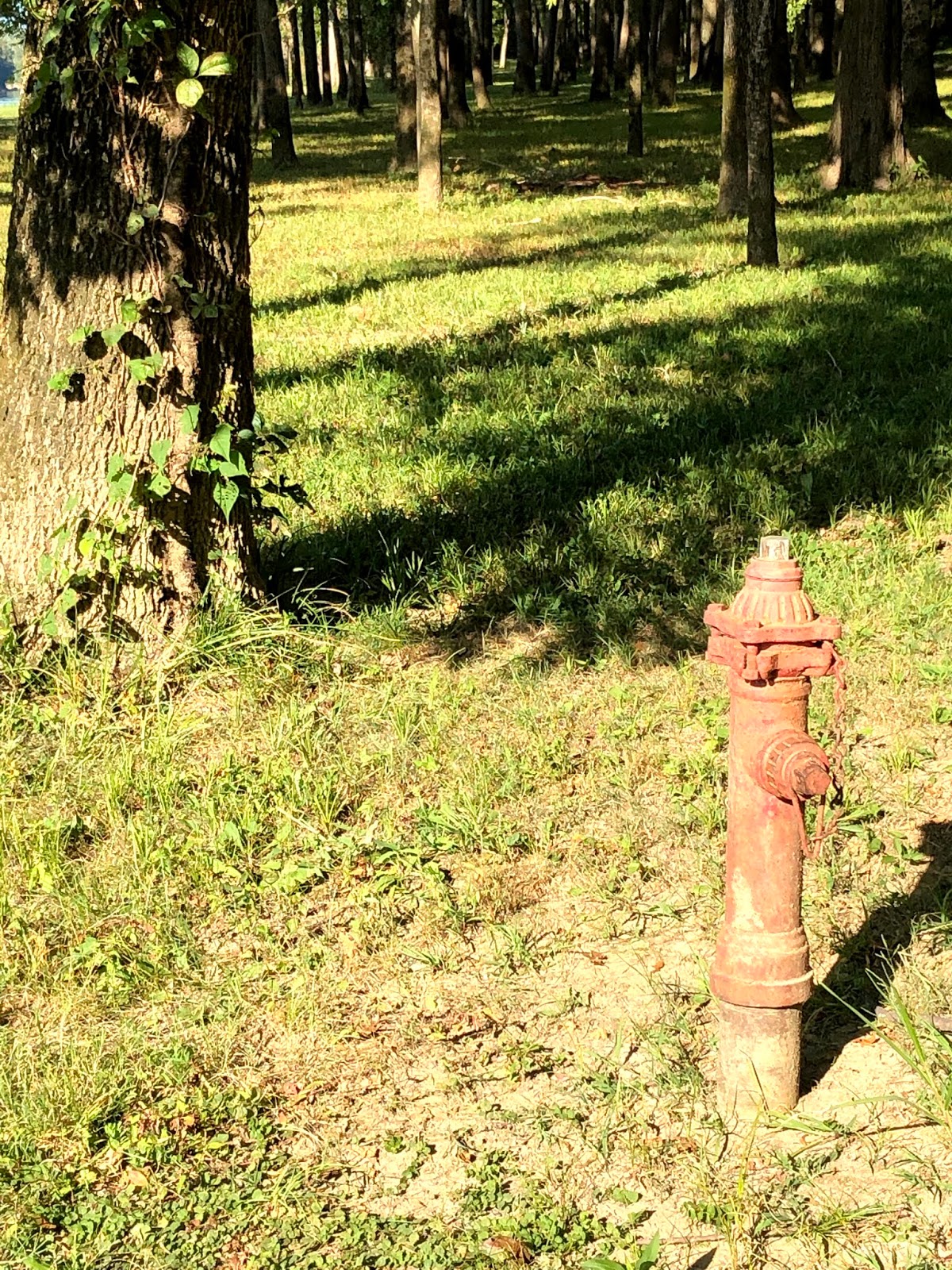
| This hydrant at the Harmonie State Park boat ramp seems reduced in stature. |
| But this one at Sara's Harmony Way is more robust, if not nearly so effective when called upon. |
Because you never know when you might need a hydrant. Water provided separately. The patio was an excellent use of the space and adds to the air of congeniality of the establishment.
Finally, it was time to turn the car toward home.
Moves 4-8:
4. Posey to Gibson
5. Gibson to Vanderburg
6. Vanderburg to Gibson
7. Gibson to Pike
8. Pike to Daviess
Game over. For now.
This was a much needed date day away. Now we look forward to learning more about Posey County and its attractions. Next time with friends.
If you have a special place in Posey County we should visit, let me know!
Subscribe to:
Posts (Atom)